
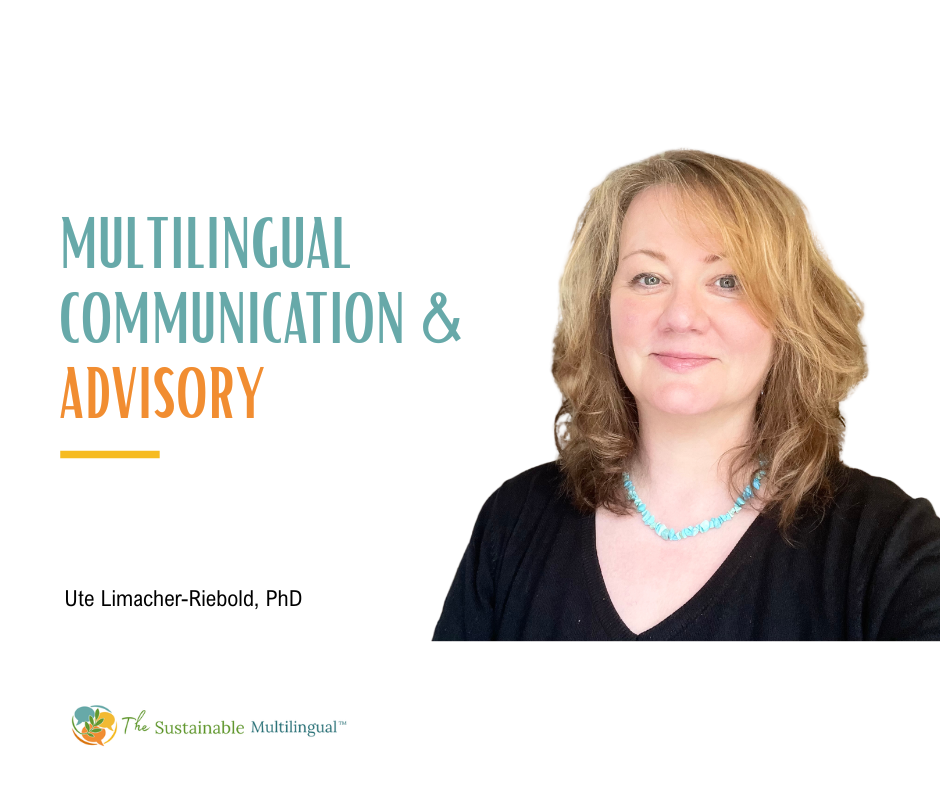
Research-based expertise for complex multilingual and intercultural challenges
I advise professionals, educational institutions and organisations on multilingual communication and intercultural challenges, helping them understand complexity, make well-founded decisions and develop approaches that can adapt over time.
– Ute Limacher-Riebold, PhD
Multilingual environments are not simply about choosing a language.
They involve different linguistic repertoires, levels of proficiency, relationships, identities, cultural perspectives, expectations and institutional or organisational practices.
Communication can work remarkably well even when people do not share the same linguistic resources. Multilingual people constantly adapt, negotiate meaning, draw on their repertoires and find ways to communicate across different contexts. Understanding what is happening beneath the surface is often the key to finding better and more sustainable solutions.
My role is to help clients make sense of complex multilingual situations, recognise the linguistic and intercultural dynamics at play, and translate research and expertise into practical decisions.
Whether you are navigating multilingual communication in an organisation, reviewing language practices in an educational setting, supporting multilingual professionals or learners, or reflecting on a complex case, I provide research-based guidance that is thoughtful, context-sensitive and designed for lasting impact.
My work is grounded in The Sustainable Multilingual™ Framework, my original research-based framework and philosophy for understanding multilingual lives and communication across languages and cultures.
The framework brings together linguistics, communication, identity, relationships, development and sustainability to understand multilingualism as dynamic, contextual and lifelong.
The framework provides the conceptual foundation; advisory work applies that thinking to real situations, decisions and contexts.
Who I Support
Educational Institutions
Schools, universities and educational organisations that have questions about multilingualism, language practices or the experiences of multilingual learners.
I offer research-based reflection and expert input on specific questions or situations, for example:
- understanding a particular multilingual situation or learner experience
- reflecting on language practices and assumptions
- discussing questions around multilingual development and learning
- bringing a multilingual and intercultural perspective to a specific challenge
The focus is not on providing a ready-made programme, but on helping institutions better understand the situation and consider possible ways forward.
Organisations & Professional Teams
International organisations, NGOs, institutions and professional teams working across languages and cultures.
I support organisations with:
- multilingual and intercultural communication
- communication across different linguistic repertoires and levels of proficiency
- collaboration across linguistic and cultural boundaries
- inclusive participation in multilingual teams
- organisational language practices and decision-making
- developing communication practices that can adapt to changing contexts
Professionals
Educators, speech and language professionals, psychologists, consultants, researchers, leaders and other professionals who encounter multilingualism in their work and want to deepen their understanding or reflect on complex situations.
I provide:
- expert reflection on multilingual and intercultural cases
- conceptual clarification and research-informed guidance
- support in translating research into practice
- a space to examine assumptions and possible approaches
- guidance for navigating linguistic and intercultural complexity
- support in developing more sustainable professional practices
Individuals & Multilingual Adults
Multilingual adults often navigate complex linguistic situations that are difficult to describe in terms of “knowing” or “not knowing” a language.
You may be:
- using several languages in different areas of your life
- adapting your communication across professional, social and personal contexts
- developing a language acquired later in life
- reconnecting with a language that has become less active
- trying to understand changes in your multilingual repertoire
- navigating questions of language, identity, belonging or communication
My advisory work can help you understand your own multilingual repertoire and make conscious choices about how you want your languages to function in your life.
For dedicated language reactivation support, see Language Reactivation.
What I Advise On
Multilingual situations rarely fit neatly into a single category. Depending on the context, our work may explore questions such as:
Multilingual Communication
- How do multilingual people communicate effectively across different languages?
- How do language choice, proficiency and context influence communication?
- How can multilingual teams communicate when linguistic repertoires differ?
- How can people adapt their communication without placing the entire burden of adaptation on one person or group?
- How can organisations create communication practices that remain effective as people and contexts change?
Multilingualism Across the Lifespan
- How do multilingual repertoires develop and change over time?
- What happens when a language becomes less active or dormant?
- How can adults continue developing languages later in life?
- How do multilingual adults navigate different linguistic identities and contexts?
- How can multilingualism remain meaningful and sustainable as life circumstances change?
Intercultural Communication
- How do linguistic and cultural perspectives influence communication?
- Where do misunderstandings arise — and what lies behind them?
- How can people communicate across different expectations and ways of interpreting situations?
- How can teams develop greater awareness without reducing culture to stereotypes or fixed communication styles?
Education & Professional Practice
- How can research on multilingualism inform educational and professional decisions?
- How can professionals better interpret multilingual development?
- What assumptions about multilingualism influence current practice?
- How can professionals develop the knowledge and judgement to navigate multilingual complexity rather than rely on one-size-fits-all solutions?
How We Can Work Together
I do not offer predetermined packages for complex multilingual situations. Every collaboration begins with understanding the context, the question and what is already happening.
Depending on your needs, our work may include:
♦ Strategic Advisory
For institutions, organisations and teams facing complex multilingual or intercultural questions.
This may involve:
- analysing a multilingual situation
- reviewing existing practices or policies
- identifying underlying assumptions and dynamics
- developing strategic options
- translating research into practical recommendations
- supporting implementation and reflection over time
♦ Expert Consultation
For individuals or professionals who need focused expert input on a specific multilingual or intercultural question.
A consultation can provide:
- conceptual clarification
- research-informed perspective
- reflection on a complex situation or case
- discussion of possible approaches
- a clearer basis for professional decision-making
♦ Ongoing Advisory
Some situations require more than a single conversation.
For organisations, institutions or professionals navigating ongoing complexity, I can provide longer-term advisory support, creating continuity as situations develop and decisions are implemented.
This may include:
- regular advisory sessions
- leadership or professional reflection
- case discussion
- strategic review
- ongoing interpretation of emerging multilingual challenges
How I Work
Every collaboration is guided by the principles of The Sustainable Multilingual™ Framework.
My approach emphasises:
- Conceptual clarity rather than quick fixes
- Context-sensitive analysis rather than generalised solutions
- Multilingual communication and relationships rather than language in isolation
- Research translated into practical action
- Adaptability and sustainability rather than short-term interventions
- Reflection and informed judgement rather than predetermined answers
I do not believe that every multilingual situation needs a new programme, policy or intervention. Sometimes the most useful step is to understand what is already happening differently.
The goal is therefore not simply to solve today's challenge.
It is to help people and organisations develop the understanding, judgement and practices they need to navigate multilingual complexity well into the future.
Engagement
Every collaboration is tailored to the context. questions and goals of the client.
Depending on your needs, we may work together through:
- Expert consultations
- Strategic advisory projects
- Short-term focused collaborations
- Medium-term advisory partnerships
- Ongoing support for institutions, organisations, teams or leaders
I work selectively and do not offer one-size-fits-all programmes.
If you are facing a multilingual or intercultural challenge and are unsure what kind of support would be most useful, get in touch to discuss the situation and explore whether my expertise is a good fit.
Contact: info@UtesInternationalLounge.com
