
Table of Contents
Toggle
Who Gets to Count as a Heritage Speaker?
One of the most troubling aspects of current discussions around heritage language speakers is how narrow and exclusionary some definitions have become.
In some contexts, children who begin actively acquiring a heritage language after the age of five are excluded from being considered “real” heritage speakers. In others, heritage speakers are expected to have “native-like” pronunciation in order to be viewed as legitimate members of the linguistic community. But what exactly does “native-like” even mean (please read this post about accent hierarchies) ? Native compared to whom? To a monolingual speaker from one specific region? One generation? One social group? One idealized standard that often does not even reflect the linguistic reality of contemporary multilingual communities?
Different Conditions, Different Outcomes
These expectations are not only unrealistic. They are also deeply counterproductive for heritage language maintenance. Families transmitting a heritage language abroad are already navigating enormous challenges: limited exposure, societal pressure toward assimilation, lack of institutional support, mixed-language environments, demanding work schedules, interrupted transmission across generations, and sometimes even criticism from both the majority society and their own communities. And despite all this, many families still make extraordinary efforts to keep their languages alive for their children.
That effort should be encouraged, not constantly evaluated against monolingual standards!
A child growing up with a heritage language abroad does not live the same linguistic reality as a monolingual child growing up surrounded by that language in all areas of life. Comparing the two as though the conditions were identical is neither fair nor linguistically meaningful. Heritage bi/multilingualism develops under different circumstances – and therefore naturally produces different outcomes. That is not deficiency. That is lived multilingualism!
When Heritage Speakers Are Excluded
What becomes especially harmful is when heritage speakers are excluded from their own linguistic and cultural communities because they “do not sound native enough.” Sometimes the exclusion is subtle:
corrections, mockery, laughter, constant comments about pronunciation. Sometimes it is explicit: “You are not really one of us.” – “You don’t speak properly.” – “You sound foreign.”
But heritage languages are not abstract academic categories! They are deeply connected to family relationships, belonging, emotional memory, identity, friendships, and intergenerational continuity. When heritage speakers are delegitimized because of their accent or non-monolingual language patterns, they are not merely being criticized linguistically. They are often being symbolically excluded from their own communities, which can have lasting consequences.
Why Shame Leads to Language Loss
Research in multilingualism and heritage language maintenance repeatedly shows that shame, insecurity, and fear of judgment are among the strongest factors leading speakers to withdraw from using the heritage language altogether. And then communities wonder why the language is disappearing across generations!
Language maintenance cannot succeed if multilingual speakers are made to feel perpetually inadequate. A heritage speaker who speaks “imperfectly”* but confidently will maintain and transmit the language far more successfully than one who has learned to remain silent out of fear of criticism.
Encouragement Instead of Perfection
This is why encouragement matters so much. We should support and celebrate families who maintain multilingualism across generations under difficult conditions. We should support children and adolescents who reconnect with their heritage language later in life. There should not be an “expiration date” for heritage language speakers. We should create spaces where multilingual speakers feel safe participating without having to prove linguistic purity.
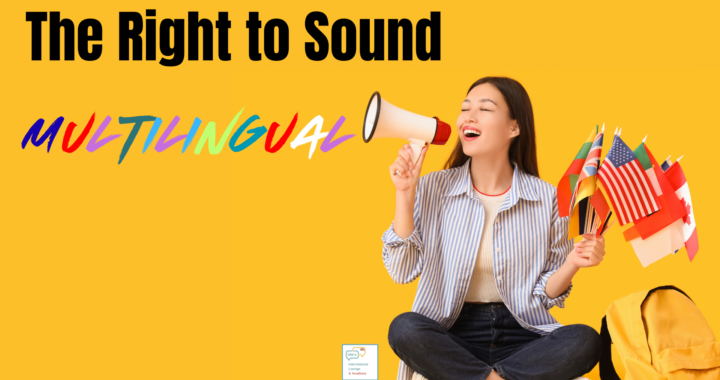
The Right to Sound Multilingual
Most importantly, we need to stop treating monolingualism as the invisible norm against which all multilingual speakers are measured. Heritage speakers are not failed monolinguals, they are multilingual individuals with complex linguistic biographies – and their accents tell the story of those experiences.
Multilingual speakers should never be evaluated according to monolingual ideals.
Multilingualism is not an incomplete form of monolingualism: it is a different linguistic reality altogether.
References for further reading:
– Flores, N. & Rosa, J. (2015). Undoing appropriateness: Raciolinguistic ideologies and language diversity in education. Harvard Educational Review. 85 (2). 149-171.
A foundational text showing how multilingual speakers are judged according to racialized and monolingual norms rather than actual communicative competence.
– García, O. (2008). Bilingual Education in the 21st Century: A Global Perspective. Wiley-Blackwell.
Strong critique of monolingual standards and the idea that bilinguals should approximate monolingual speakers.
– Grosjean, F. (1989). “Neurolinguists, beware! The bilingual is not two monolinguals in one person.” Brain and Language, 36(1), 3–15.
A classic and highly quotable argument against comparing bilinguals to monolinguals.
– Grosjean, F. (2010). Bilingual: Life and Reality.
Accessible discussion of bilingualism as a complete linguistic system in its own right.
– Leeman, J. (2015). “Heritage language education and identity in the United States.” Annual Review of Applied Linguistics, 35, 100–119.
Addresses legitimacy, identity, and the emotional dimensions of heritage language learning.
– Montrul, S. (2022). The Acquisition of Heritage Languages. CUP.
Important overview emphasizing variability and the diversity of heritage speaker trajectories.
– Ortega, L. (2019). “Toward a reconceptualization of nonnative speakerhood.” In The Cambridge Handbook of Language Learning.
Critiques native-speakerism and monolingual bias in language research and education.
– Valdés, G. (2000). “Introduction to: Heritage Languages Instruction in the United States: A Time for Renewal”. Bilingual Research Journal. 24 (4).
One of the foundational discussions of heritage language speakers as a distinct multilingual population rather than deficient native speakers.
– Zentella, A. C. (1997). Growing Up Bilingual: Puerto Rican Children in New York.
A powerful ethnographic work showing bilingualism as socially situated, dynamic, and deeply tied to belonging and identity.
– Dewaele, J.-M. & Wei, L. (2013). “Is multilingualism linked to a higher tolerance of ambiguity?”Bilingualism: Language and Cognition.
Indirectly useful for discussing multilingual flexibility and non-monolingual norms.
*for someone who is not used to listen to a broad variety of speakers of the language

Thank you for discussing this delicate issue. Shame leads to language loss rings out from your post.