

Please find a list of resources you can use to foster Arabic at home. As Arabic is a language I still don’t master (yet), I invite you to share other links to sites that provide resources to teach Arabic – understanding, speaking, reading, writing – for children from 0-18 yo, and also for adults, in […]
Continue readingCategory Archives: Multilingual

Code Switching and Code Mixing
Before explaining how the terms of code-switching and code-mixing are used, what they mean, let’s have a look at the history of the term of code-switching. Where does the term of code-switching come from? The first one introducing the metaphor of a language switch, i.e. the changing from one language to another during a conversation, […]
Continue reading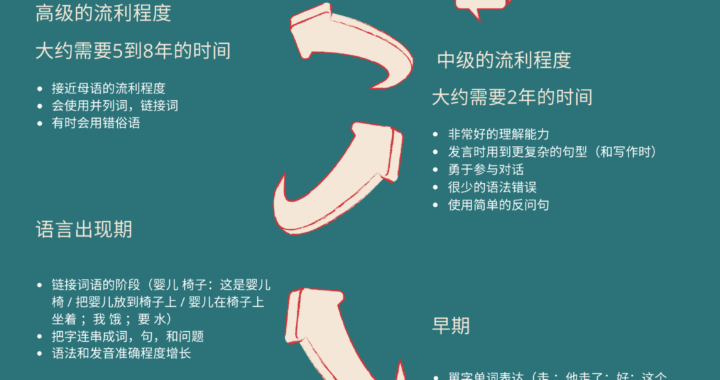
新语言习得的5个阶段 / 5 Stages of additional Language Acquisition
If your child is acquiring Chinese as an additional language, you may find this infographic useful. Thanks to Yu Xun, a young intern at Ute’s International Lounge, and Amanda, owner of Miss Panda, my infographic 5 Stages of Additional Language Acquisition got translated into Chinese. Following an interesting discussion with some clients and members of my […]
Continue reading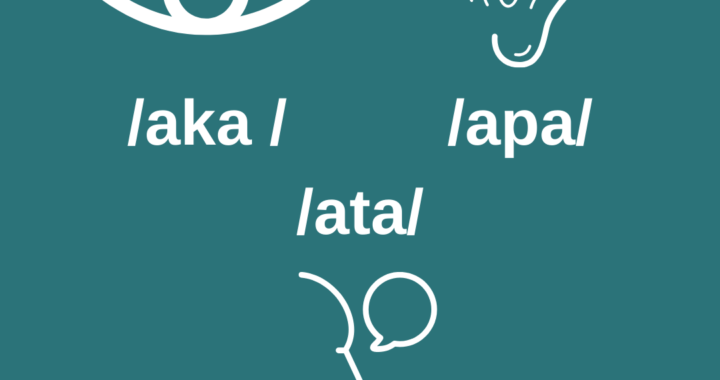
The illusion of sound and its meaning in language acquisition and learning
Sound is the most important medium we use when communicating – unless, of course, we use sign language. Most of us assume that the auditory signal is enough for others to understand us. Some people increase the volume to make sure they are “heard”. Most of my clients are surprised to learn that sound is […]
Continue reading
Sensible and sensitive – in French and English
Like many people who regularly use more than one language, I have some words I use in an incorrect way because the same – or similar – form of the word has a different meaning in another language I speak. Native speakers would probably not make those mistakes, but I personally consider them as an […]
Continue reading