
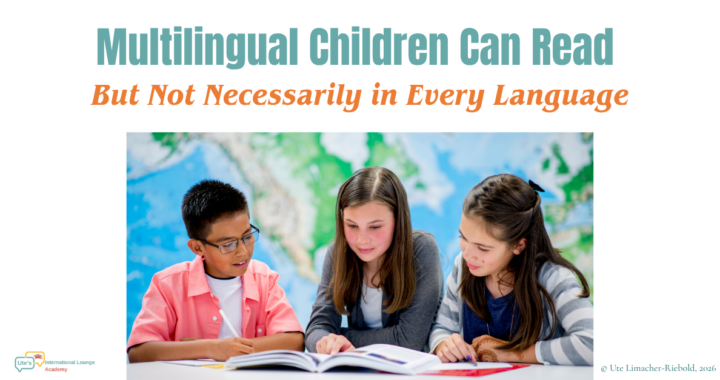
To understand a multilingual child’s reading development, we need to consider not only the language and its writing system, but also the learner’s actual experience with literacy in that language.
Continue readingCategory Archives: Multilingual
Beyond the Accent – Heritage language speakers are not failed monolinguals
Who Gets to Count as a Heritage Speaker? One of the most troubling aspects of current discussions around heritage language speakers is how narrow and exclusionary some definitions have become. In some contexts, children who begin actively acquiring a heritage language after the age of five are excluded from being considered “real” heritage speakers. In […]
Continue reading
Who is a Heritage Language Speaker?
Heritage language speakers occupy a unique and often misunderstood position within multilingual societies. In many parts of the world, millions of children grow up hearing one language at home while becoming educated and socially integrated through another. These individuals are frequently described as “heritage language speakers.” Yet despite the term’s widespread use, there is no […]
Continue reading
The Voice and the Self: How Accent Shapes Who We Are
After exploring how accents are perceived, evaluated and adapted, a final question remains: Why does all of this feel so personal? Accent is not just pronunciation. It is your linguistic biography. Among all features of language, accent may be the most intimate. Vocabulary can be learned from textbooks, grammar can be practiced and […]
Continue reading
Training the Ear: Listening as a Social Skill
Discussions about accent tend to focus solely on the speaker and language learners are often encouraged to reduce their accent, improve their pronunciation and approximate native patterns of speech. Entire industries have developed around accent training and pronunciation coaching with the aim to help language learners to become more intelligible as possible when using the […]
Continue reading