
My work with multilingual families is grounded in the conviction that multilingual development can only be understood when languages are seen in relation to each other, to life domains, and to lived experience. Rather than treating languages as isolated systems or counting them as static skills, I work with Dominant Language Constellations (DLCs) and Language Timelines© as complementary tools that make the life with multiple languages visible, discussable, and actionable.
Most of my clients are interlingual families – families in which different languages, varieties, and modalities meet across generations, partnerships, educational contexts, and migration histories.
In such families, language development is rarely linear. It is shaped by access, opportunity, ideology, and biography.
The Dominant Language Constellation makes multilingual repertoires visible
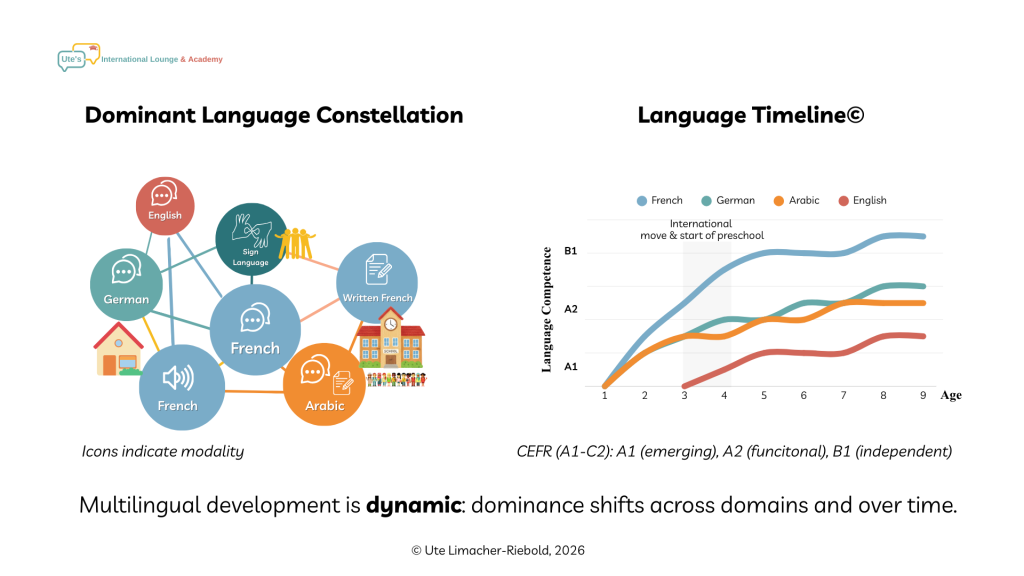
The concept of the Dominant Language Constellation (DLC) was developed to describe the small set of languages that are dominant for a person’s everyday functioning at a given point in time (Aronin & Lo Bianco, 2020). Dominance in this sense is functional rather than evaluative: it refers to which languages are used for example for learning, emotional expression, social interaction, professional life; not to prestige or proficiency alone.
I use the DLC as a visual thinking tool with the multilingual families I work with. Together with parents/caregivers we map which languages are dominant for which domains, in which modalities (spoken, written, signed) and under which conditions etc.. I often also draft DLCs for each member of the family, because everyone's language constellations shift over time, and visualizing various phases of language development can help identify the crucial moments for shifts in language use. This visualisation process usually brings relief and clarity: it shows that using different languages for different purposes, to various extent and levels of proficiency is very normal in multilingual lives.
DLCs are particularly helpful when families experience complexity, tension, or uncertainty – whether due to migration, schooling choices, literacy development, or differing expectations between home and institutions. By externalising the constellation, families and professionals can talk about language use without blame, hierarchy, or oversimplification.
Language Timelines©: Adding a biographical dimension
While the single DLCs capture a snapshot of functional dominance at a particular moment, the Language Timeline© – that I developed and which is based on the Dynamic Model of Multilingualism by Herdina and Jessner (2002) – adds a longitudinal perspective. It traces when, how, and under which circumstances languages entered a person’s life, became stronger or weaker, were interrupted, reactivated, or emotionally re-evaluated.
Language Timelines are particularly powerful in interlingual families because they:
- make visible periods of intense exposure or reduced access,
- contextualise temporary delays or asymmetries,
- highlight the impact of schooling, migration, and family change,
- reconnect language development with biography and identity.
Used together, the DLC and the Language Timeline prevent static interpretations. They show multilingual development as dynamic, adaptive, and context-sensitive, rather than as a linear path toward a single “target language.”
Working in contexts of constraint
Much of my research and advisory work focuses on multilingual development in contexts of constraint. These may include limited access to certain languages or modalities, institutional monolingual norms, interrupted educational trajectories, or competing expectations between family and school.
The combination of DLC an Language Timelines, allows to distinguish between structural constraints and individual resources. This distinction is crucial for ethical, inclusive language advising. It shifts the focus away from perceived deficits and toward questions of access, opportunity, and realistic support.
Research-informed, family-centred, and dialogic
My approach draws on sociolinguistic research on multilingualism, biographical approaches to language learning, and inclusive, strength-based frameworks. At the same time, it is deeply dialogic. Families are not passive recipients of expertise; they are co-analysts and agents of their own linguistic lives.
Whether I work with parents, educators, or professionals, my aim is always the same: to create shared understanding, to reduce anxiety around multilingualism, and to support informed, realistic decisions that respect both children’s needs and families’ linguistic identities.
Selected references
Grosjean, F. (2010). Bilingual: Life and reality. Harvard University Press.
Limacher-Riebold, U. (2026). The dynamic DLCs of mobile multilingual families. in L. Aronin & E. Vetter (Eds.), Dominant Language Constellations for Teachers: A practical dimension. 238-261.
Wei, L. (2018). Translanguaging as a practical theory of language. Applied Linguistics, 39(1), 9–30.
