

In Language, Shame, Guilt and Anxiety I explored how language anxiety and language shame shape the emotional experience of multilingual speakers.

Accents are often treated as purely linguistic features: systematic, distinctive patterns of pronunciation that indicate a speaker's regional, social or ethnic origin. In reality, all speakers have an accent, and none is inherently superior. Yet accents function as social markers, influencing how speakers are perceived, evaluated and included (or excluded). And multilinguals are judged about their (foreign) accents within seconds, before they even finish the first sentence...
There are many aspects about accents that we need to be aware of, which is why I am writing this series that begins with a moment many people recognize but rarely examine: what happens when understanding becomes difficult.
In the opening article, From “Zoning Out” to Understanding: Rethinking Communication Across Accents, I show that communication across accents is not the responsibility of the speaker alone. From the very beginning, it is co-constructed. What appears to be a problem of comprehension often reflects a dynamic interaction between processing effort, attention, and expectation.
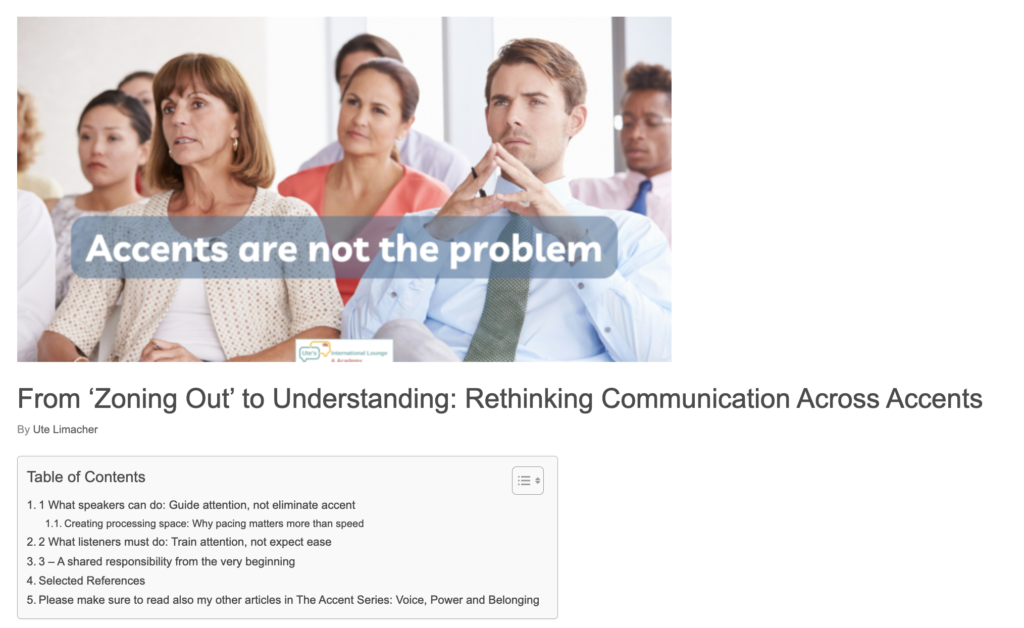
Building on this foundation this series explores how accents shape communication, social perception and identity. It brings together insights from sociolinguistics, psycholinguistics and intercultural communication to examine how we hear, evaluate and adapt to different ways of speaking.
- How listeners move from processing difficulty to social judgement
- How accent hierarchies emerge and why some ways of speaking are treated as more legitimate than others
- How speakers adapt their voices to navigate these hierarchies
- Why listening itself is a skill that must be developed in multilingual contexts
- And how accent is deeply connected to identity and belonging
Instead of focusing on speakers only when it comes to accents, it is about time to involve the listener in the equation, as speakers and listeners both carry the responsibility for effective communication.
Accent is not merely a phonetic feature, but a biography made audible. Understanding how accents are perceived allows us to move beyond simplistic ideas about “good” and “bad” pronunciation and toward a more realistic view of language in society. The aim of this series is not to deny linguistic standards. It is to ask a deeper question:
What happens when pronunciation becomes a proxy for human worth?
Exploring this question helps us better understand how communication works in multilingual contexts – and what it takes to make it more effective.
