
Have you ever noticed that you sound different depending on who you’re talking to?
When certain ways of speaking are consistently valued more than others, speakers rarely remain unaffected. Instead, many begin to adjust to their social environment.
A person may pronounce certain words differently at home than at work. A student may sound one way with friends and another way in a classroom presentation. Migrants often notice that their pronunciation shifts subtly depending on the language they are using or the people they are speaking to. This adaptation is not random. It is shaped by the same hierarchies that determine which accents are perceived as legitimate.
Sometimes these changes are deliberate. Speakers may consciously adjust their pronunciation to align with a more prestigious accent to reduce stigma or increase social acceptance. In sociolinguistics this practice is often described as accent passing.
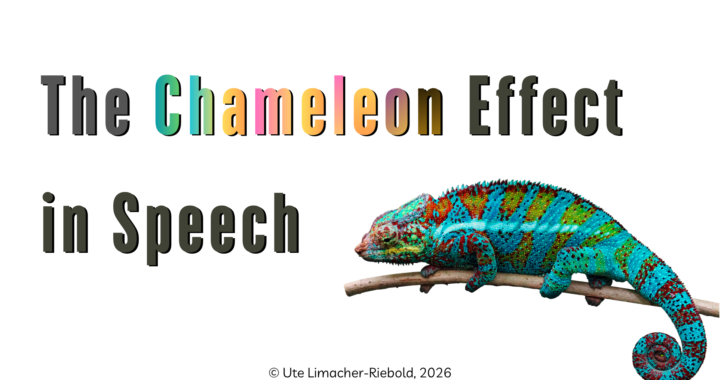
In many cases, however, the adaptation is not fully conscious. Psychology offers a helpful concept for understanding this phenomenon: the chameleon effect.
The term was introduced by Tanya L. Chartrand and John A. Bargh in the 1990s. They observed that people often engage in what they called unintentional mirroring: the subconscious imitation of gestures, posture, speech patterns and other behaviors during social interaction.
By mirroring another person’s behavior – including voice modulation or accent – individuals signal affiliation and reduce perceived social distance.
Talking about accents, we should also be aware of the chameleon effect it can have on children. When they enter new social environments, they may copy accents, expressions and behavior in order to fit in and avoid standing out. This adaptation often occurs subconsciously.
Many multilingual adults recognize this experience as well. When moving between languages or cultural contexts, they may adjust pronunciation or speech rhythm without consciously deciding to do so.
This tendency reflects a universal human motivation: the desire to belong – but also the need to be recognised as legitimate.
However, when accent hierarchies are strong, this natural adaptation can become a form of pressure. Speakers may feel that sounding different carries social costs.
Accent passing can therefore create tension between authenticity and acceptance. A person’s way of speaking reflects biography, family history and linguistic experience. Adjusting it may open doors, but it can also feel like suppressing part of one’s identity.
Recognizing this dynamic helps us understand why accent discrimination matters. It influences not only communication but also how individuals position themselves socially.
Reducing accent bias means creating environments where adaptation becomes a choice rather than a necessity.
Accent adaptation then becomes visible not simply as a linguistic adjustment, but as a response to social structures that assign value to certain ways of speaking over others. What appears to be “natural” speech adjustment is often a quiet negotiation between belonging, credibility, and identity.
Selected References
Chartrand, T. L., & Bargh, J. A. (1999). The chameleon effect: The perception–behavior link and social interaction. Journal of Personality and Social Psychology, 76(6), 893–910. https://doi.org/10.1037/0022-3514.76.6.893
Dewaele, J.-M. (2010). Emotions in multiple languages. Palgrave Macmillan.
Lippi-Green, R. (2012). English with an accent: Language, ideology, and discrimination in the United States (2nd ed.). Routledge.
