
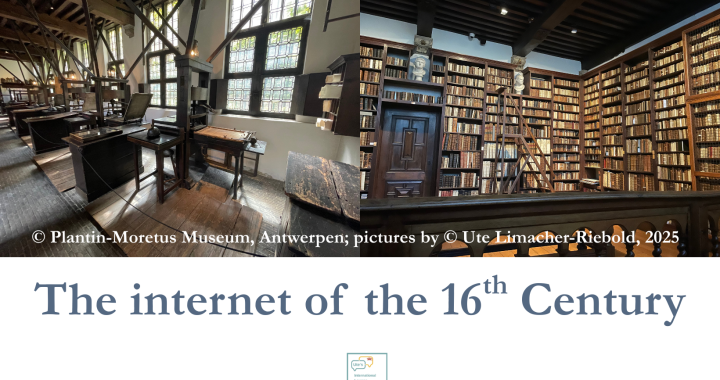
When we think of the internet today, we imagine a network that connect people, ideas, knowledge across the globe. In the 16th century, however, a different but equally informative network emerged in Europe: the printing press. For the first time in European history, texts could be reproduced quickly and distributed widely, connecting scholars, merchants and religious communities across borders.
Print as a Multilingual Network
Much like our digital platforms today, the early modern book market was inherently multilingual. Antwerp, Venice and Basel became the equivalent of digital "hubs", where printers and publishers produced works in Latin, Greek, Hebrew and the vernaculars of Europe. These books spread not only religious teachings but also scientific, philosophical and linguistic knowledge across linguistic divides (Hoftijzer, 2007).
"During the sixteenth century, Flanders formed the economic hub of the Low Countries and Antwerp was the main port of north-west Europe. A great many foreign merchants lived in the city and there were dozens of schools where modern languages such as French, English, Italian and Spanish could be learned." (Wilhem, 2018)
Christophe Plantin's Plantin Press in Antwerp exemplified this multilingual "internet". His Biblia Polyglotta (1568-1572) offered the Old Testament in Hebrew, Greek and Latin, allowing readers from different linguistic and cultural backgrounds to engage with the same text. Just as websites today appear in multiple languages – although not yet (!) as multilingual friendly as I expect and would wish... – to reach global audiences, Plantin's polyglot editions provided access to knowledge across Europe's diverse language communities (Bakker, 2017).
Knowledge, Power and Accessibility
The Renaissance and Reformation were driven by this print-based connectivity. For centuries, Latin had dominated as the language of the Church and academia, but with the rise of vernacular print, ordinary readers could access religious and educational texts in their own languages. This shift mirrors the way the internet democratized access to information in our own time, challenging traditional authorities and creating new spaces for dialogue.
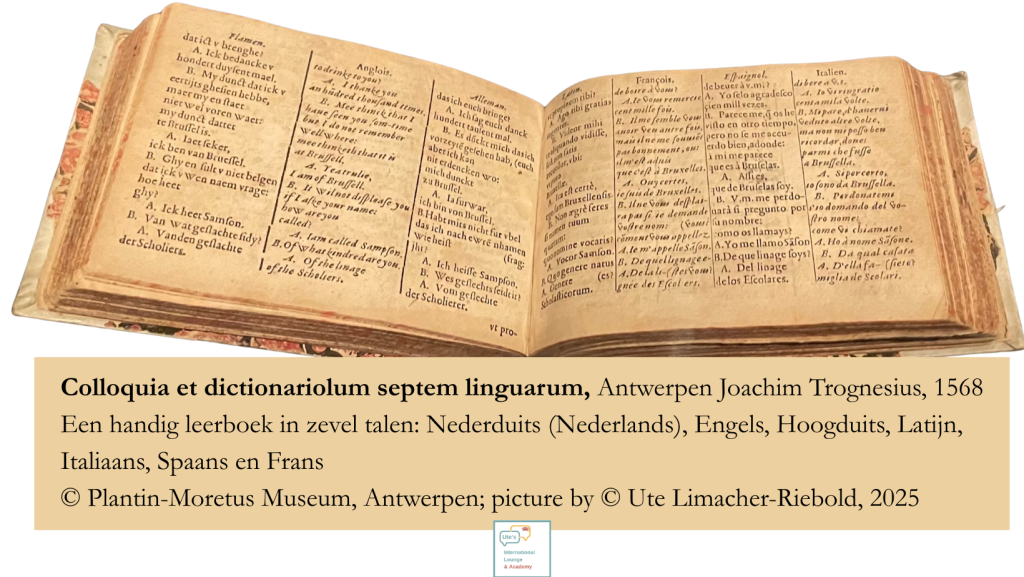
Print and Language Learning Printed books also supported foreign language learning. In the Netherlands, multilingual textbooks and grammars became tools for teaching Latin, French, German and later English, reflecting the region's strong commercial and cultural ties. Wilhelm (2018) highlights how this tradition of multilingual education, intertwined with print culture, created generations of Europeans capable of navigating different linguistic worlds – a skill just as valuable as digital literacy is today.
"Apart from the French-speaking and English-speaking immigrants, there were other groups who came to the Dutch Republic. Many immigrants came from the neighbouring German-speaking area and a smaller group from Spain and Portugal. The speakers of German either sought employment in Holland or came to study at one of the Dutch universities. Jewish immigrants had found refuge there after their expulsion from the Iberian Peninsula at the end of the fifteenth century. Like the English and Scottish dissidents, the Jews were often engaged in the production and distribution of books, such as Hebrew literature and books in Spanish and Portuguese (Frijhoff and Spies: 274–275). All in all, the presence of these migrant groups in the Republic played a key role in spreading the knowledge of foreign languages." (Wilhelm, 2018)
Conclusion
The printing press was more than a technology of reproduction: it was Europe's first "internet", a network that spread ideas, fostered intercultural understanding and challenged linguistic and political boundaries. Just as our digital platforms today shape identities and connect communities, the printed book of the 16th century was a medium of transformation – one that made multilingualism, knowledge and exchange accessible on an unprecedented scale.
If you are in Europe/Belgium, I invite you to visit the Museum Plantin Moretus.
