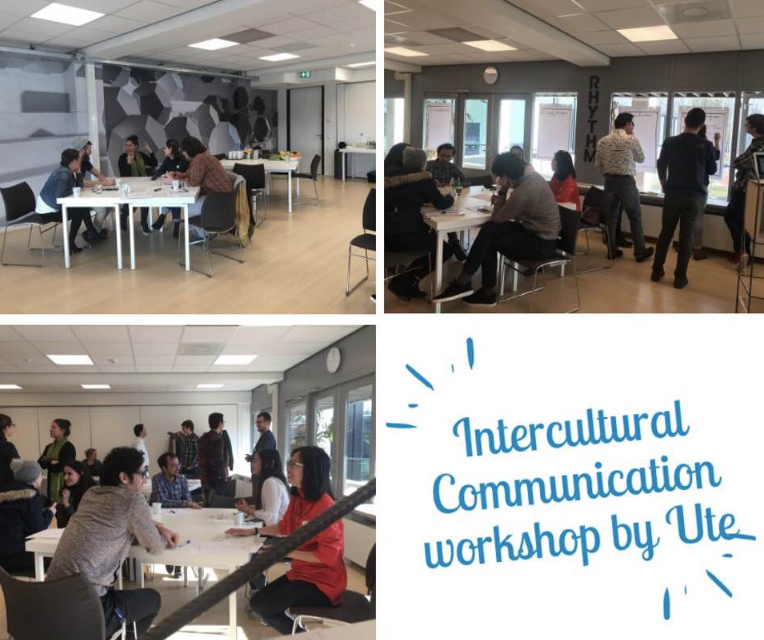
In my trainings for teams I focus on intercultural communication which is one domain where culture as concerned with the specific – and different! – ways of life of different national and ethic groups is constructed (Ingrid Piller, 2017: 10).
My aim is to help international employees become aware of the many ways we can communicate in international settings.
Participants of my trainings reflect on their own experience, and gain proficiency at becoming efficient communicators through:
- acquiring the ability to successfully communicate verbally and non-verbally,
- behave effectively and appropriately with people from other cultural groups,
- handle the psychological demands and dynamic outcomes that result from these interactions.
Tailored in person and online workshops
Designed for professional teams working in international and multilingual settings.
Pricing*
- 2-hour training / webinar (minimum 10 participants): €500
A concise introduction to multilingual and intercultural dynamics with reflective exercises and orienting tools for immediate application. - 4-hour training / webinar (minimum 10 participants): €4,200
An interactive session combining theory, reflection, and case-based discussion to support confident interpretation and inclusive workplace practices.
*excl. travel costs
WHAT IS CULTURE?
Culture can be defined in many different ways. The definition that most closely reflects how I understand and experience culture is the following:
A fuzzy set of basic assumptions and values, orientations to life, beliefs, policies, procedures and behavioural conventions that are shared by a group of people, and that influence (but do not determine!) each member's behaviour and his/her interpretations of the "meaning" of other people's behaviour
(Helen Spencer-Oatey, Culturally Speaking: Culture, Communication and Politeness Theory, 2008)
This definition highlights an important point: culture shapes how we interpret the world and interact with others, but it does rigidly determine our behaviour. Each person engages with culture in their own way.
Intercultural Communication Training
Each of us has a preferred communication style that comes with its own strengths and limitations.
When we live abroad or work in international settings, we often discover that our expectations about behaviour, beliefs, rtaditions or communication are not always shared by others. Situations that seem clear and natural to us may be interpreted differently by people from another cultural background.
As I often say:
"We all experience diversity based on our own experiences, assumptions, beliefs, traditions – that's our very own cultural backpack."
Becoming aware of our own communication style is the first step toward understanding how others communicate. This awareness helps us develop greater mutual understanding and more effective interactions.
Intercultural communication is not only about learning facts about another culture. It is also about understanding how communication works: how we speak, liksten, write, use gestures, interpret silence and respond to emotions in conversation.
Being multilingual and multicultural is a great asset to thoroughly understand diverse cultures: their values, beliefs and social norms.
Experiencing different cultures is often like looking at the world through constantly adjusting lenses. The better we understand what we see, the better we can adapt our communication style and engage in meaningful and productive conversations.
Respecting Cultural Diversity
Understanding another culture does not mean abandoning your own. As Edward T. Hall emphasized:
When you understand another culture or language, it does not mean that you have to loose your own culture.
Rather than judging other cultures, the goal should be to help people understand the relationship between their own cultural background and the dominant culture around them – while people from the dominant culture also develop awareness of other cultural perspectives.
Mutual understanding always works in both directions!
What You Will Learn in My Trainings and Workshops
In my intercultural communication trainings and workshops, participants explore practical strategies to improve communication across cultures. Together we examine questions such as:
– How is your own communication style perceived by others?
– How does your communication style influence how you interpret other people's behaviour?
– How does your way of communicating change when you use another language?
– What role does non-verbal communication play?
– How can you actively listen and build rapport?
– How can you communicate effectively in challenging situations?
– How do you deal constructively with criticism or aggression?
– How can you speak more clearly and effectively in intercultural contexts?
– How can you avoid misunderstandings and communicate with greater confidence?
You can also explore these topics in my articles on intercultural communication.
About Ute
Ute is a qualified intercultural communication trainer who has spent her entire life living outside the passport country of her parents. Growing up and living internationally has allowed her to experience many cultures from the inside and to understand the complexities of integrating into new environments.
Over the years, she has lived abroad for family reasons, for study, and for work. She has also experienced different life roles, including working professional, sole breadwinner and accompanying partner. Today, her three children are also growing up internationally.
Ute has worked in international environments in Switzerland, Italy and the Netherlands. Her trainings are always tailored to the specific needs of the participants and their professional or personal contexts.
Through her work, she has supported hundreds of international professionals and families in understanding new cultural environments, navigating linguistic and cultural differences, and communicating effectively and respectfully across cultures.
The contents were so helpful and the lecturer was really professional. Thank you for arranging this valuable event. – Participant of TU Delft Coming to Delft & Partner Career Advice
I moved to NL from the States 12 months ago and had a hard time. After an easy start, things kept getting worse and I didn't know what to do, if returning back home or not. My children just started to settle in at school and made new friends. I felt that I was failing. When Ute told me that this is what can happen to expats and guided me through this stage, I felt a huge relief. – I'm still in the NL and am volunteering at school. I'll soon do my NT2 and hope to find a job soon. – Kaitlyn G. (participant of workshop: Welcome to The Hague)
I wish I had this workshop right after my arrival. It took me tons of time to find the places I
needed and to me it was way more beneficial than the introduction I got in the beginning weeks! – Beatrice K. (employee at TU Delft)
Ute's workshop was a real eye-opener! I would have needed this workshop 3 years ago...! (Anna Carla S.)
Ute's workshop is fantastic! She gives so many insights into every day life with locals. I live here 10 years now but learned so much from her! Amazing! (Melanie R.)
The workshop was very clear and well balanced. I loved that she also talked about the language. Very helpful and welcoming for someone who just moved here. (Catherine D.)
The workshop was very informative, good humored and the best presentation I saw! Well done and thank you! (Paul O.)
I learned a lot of things about Dutch people. A good way to introduce myself with my neighbors, how to do it and when. Very informative! (Jia H.)
Ute gives very good tips and clarification about Dutch culture. Super presentation! (Steve C.)
In her workshop about Dutch Culture, Ute not only gave answers about typical practice and expectations in terms of how formal emails/letters salutations should be depending on the context, but also about body language, gestures and much more! (Elena P. partner at TU Delft)
I learnt a lot! Especially about everyday life of people in the Netherlands and their body language. (Maria-Laura P. partner at TU Delft)
I just wanted to say thank you Ute for your excellent course and teaching. I really enjoyed it and it was so much more than I expected, I learned loads in just one day. I also wanted to compliment you on your training skills and excellent presentation. I love your teaching style especially your use of hand gesture. It’s a pleasure to learn from you. – (Helen H. partner at TU Delft)
Working with Ute is always a pleasure, she is a true professional who acts proactively. She is highly skilled and knowledgeable in the intercultural field. She shares useful insights with our workshop participants and helps new international employees of TU Delft and their partners to understand how The Netherlands is organized and what they can expect of working with the Dutch. – (Fabiënne Scholte-Buijs, HR, Coming to Delft Service for new international colleagues | Partner Career Advice | Intercultural Communication; TU Delft)
I like how Ute encourages participants of her workshops to first determine their own expectations, share their experiences and reflect, then discover what is similar and what not in the new culture and language, before support their understanding of what might be easy for them and what might be more challenging for them, setting small action steps. – Maria Elena P. (Intercultural Relations Student and Intern at Ute's International Lounge, 2019)