
Multiliteracy is a tremendous asset for our children – but the path to becoming literate in more than one language is rarely straightforward. For teenagers especially, literacy development is shaped by motivation, school requirements, and the unique characteristics of each language.
Reading Across Languages
Literacy in multiple languages often starts at home with reading aloud. In our family, we read in German, Italian, Dutch, and English – and even translated picture books into Swiss German, which has no written form. This practice showed my children that “reading the picture” can be just as meaningful as reading the words. It nurtured their storytelling skills, comprehension, and curiosity.
The Reading Rope model (Scarborough, 2001) reminds us that reading fluency emerges from weaving together decoding and language comprehension. Parents and teachers can strengthen both strands by reading aloud, encouraging storytelling, and asking reflective questions – in every language a child uses.
Read more about the Reading Rope on my blog
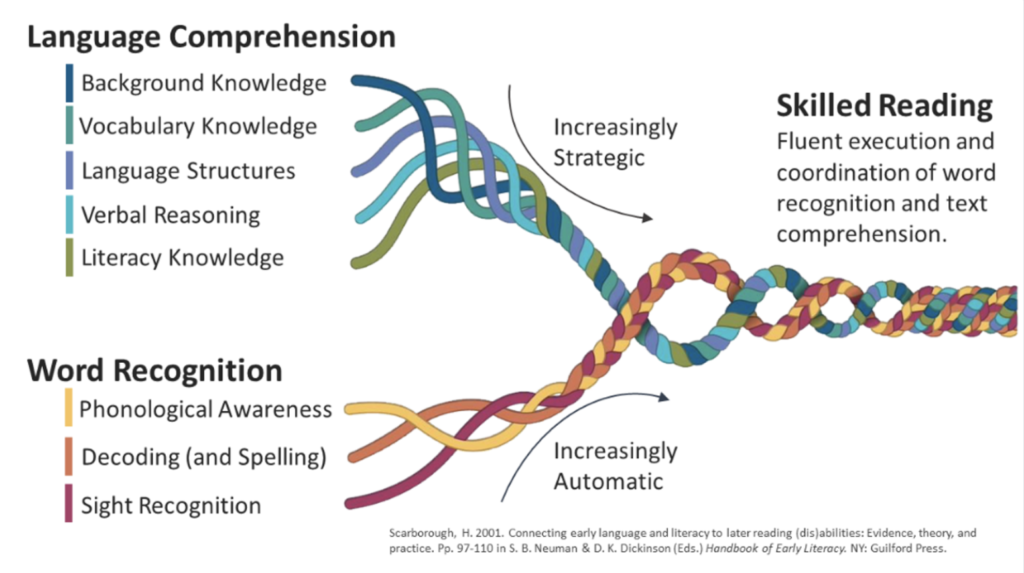
But reading does not develop the same way across languages. English orthography is famously opaque, German is more transparent, and Italian has an almost one-to-one letter–sound correspondence. These contrasts help children make fascinating cross-language connections. At the same time, they mean that decoding skills may transfer across languages, while comprehension often lags behind. For example, a child may sound fluent when decoding aloud in English but still struggle to follow the storyline.
Asynchronous Literacy
It is important to remember that literacy across languages is not simultaneous or linear. Unless children are learning to read and write in multiple languages at school (for example in dual-language or CLIL programs), they will not progress evenly across all their languages.
Dr. Sabine Little (2020) uses the concept of Asynchronous Literacy to describe this phenomenon: multilingual children may be advanced readers in one language while still developing basic skills in another – and this is perfectly normal.
Watch our interview with Dr. Sabine Little on Raising Multilinguals LIVE
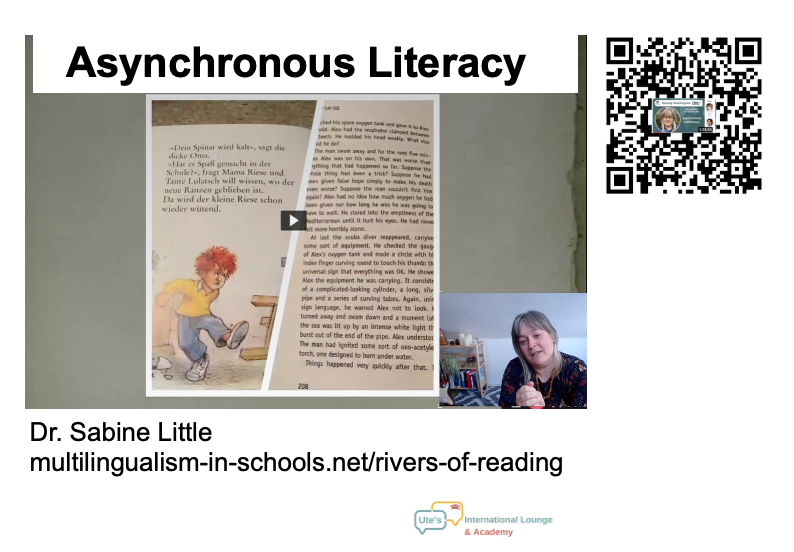
This asynchronicity reflects differences in exposure, need, and motivation across contexts. Recognizing it helps parents and teachers set realistic expectations and celebrate progress in each language on its own terms.
For teenagers especially, motivation becomes the driving force. Their reading and writing skills flourish when connected to real-life needs and interests: preparing for exams, pursuing hobbies, connecting with peers, or staying in touch with family abroad. Rather than striving for equal skills in every language, it is more efficient and motivating to celebrate individual asynchronous growth as a natural feature of multilingual development.
The Dominant Language Constellation
A useful concept for understanding multilingual literacy is the Dominant Language Constellation (DLC), originally introduced by Aronin & Ó Laoire (2004, 2011). The DLC describes the set of languages in a multilingual person’s repertoire that play the most significant role in daily life. Which languages are “dominant” depends on the context: home, school, community, peers, or online spaces.
For teenagers, this constellation often includes the school language, the community language, and one or more family languages. However, not all languages in their repertoire will have equal weight. For instance, a teen might use German for school, English online with friends, and Spanish at home with family – while another heritage language (e.g., Italian) remains in the background.
This framework helps explain why literacy development is uneven: children naturally invest more energy into the languages that are most relevant to their daily lives. A dominant school language typically develops rich academic literacy, while home languages may remain focused on family communication unless they are actively supported.
Understanding the DLC encourages parents and teachers to:
-
Recognize which languages are truly dominant for the child at this stage.
-
Accept that not all languages will develop to the same literacy level.
-
Provide scaffolding in weaker but still valued languages through meaningful activities (letters, journals, creative projects).
By embracing the DLC, we see multilingual literacy not as a race for balance but as a dynamic constellation that shifts with context, motivation, and opportunity (Limacher-Riebold, 2025).
Writing: A Complex Skill
While listening and speaking are skills we acquire naturally, reading and writing require formal instruction. Reading is often easier to transfer across languages, but writing is far more complex. It demands mastery of grammar, spelling, vocabulary, text structures, and stylistic choices – all of which vary across languages and require explicit teaching.
For multilingual teens, switching between these systems can feel overwhelming, especially if they have only received formal instruction in one of their languages.
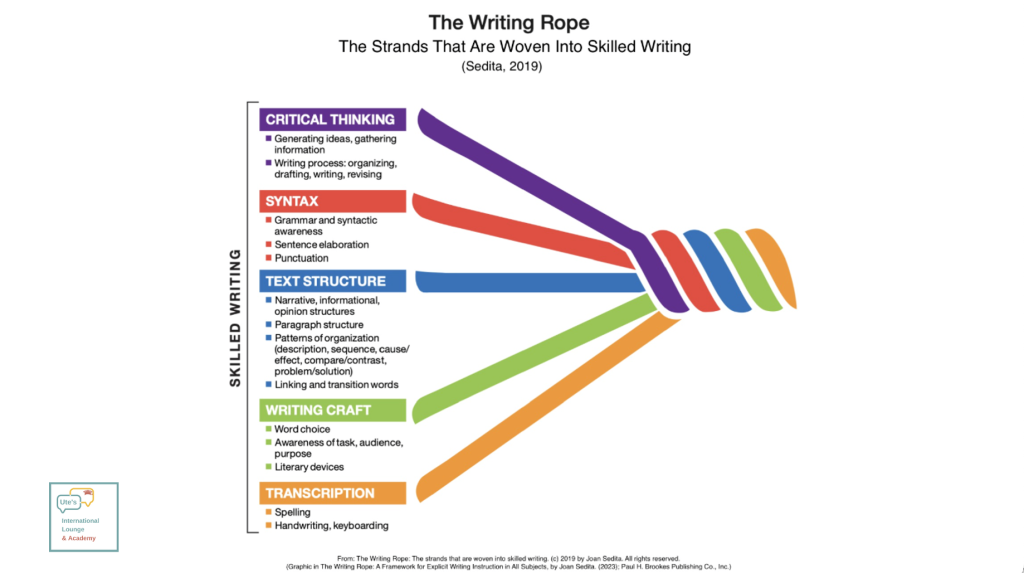
The Writing Rope framework (Sedita, 2019) is helpful here: it shows how strands such as syntax, text structure, and critical thinking interweave to form skilled writing, aligning with Cummins’ (2000) Common Underlying Proficiency (CUP) theory, which explains how cognitive skills can transfer across languages. Nevertheless, syntax, writing craft and transcription, as well as critical thinking can differ considerably across languages, and are skills that require years of practice.
Translanguaging – Opportunities and Limits
In recent years, translanguaging practices have been praised for allowing children to use their entire linguistic repertoire (García & Wei, 2014). This is a positive shift away from restrictive “school language only” policies.
Yet, for many multilingual children, especially those who acquired their home languages early and without formal instruction, these languages are often used for family communication only. They may lack the academic vocabulary to discuss school subjects in their heritage languages. This explains why many multilinguals schooled in an additional language gravitate toward that language for academic contexts.
Saturday schools and heritage language programs can support literacy, but with only a few hours per week, they rarely match the breadth and depth of subject-specific instruction received in the school language. Unless children have the rare opportunity to attend bilingual or CLIL programs in their home languages, they will not achieve full academic parity across all their languages.
This is not a weakness, but a reality. To make translanguaging meaningful, teachers must be aware of what each student can actually do in their home language. Otherwise, there is a risk of making students feel inadequate.
– I invite you to also read my post about the various kinds of multilingual learners.
Supporting Writing Across Languages
Families can encourage writing in meaningful, engaging ways: journals, letters to relatives, or bilingual creative projects. Teachers, on their side, scaffold each strand of writing development with explicit instruction – usually in the school language.
When transferring these skills to a home language, it helps to know how each language differs in:
- Critical thinking: how ideas are planned, organized, and structured
- Syntax: sentence rules and punctuation conventions
- Text structures: narrative, opinion, informational, formal vs. informal
- Vocabulary choices: word selection for different registers and styles
- Transcription: spelling, handwriting, keyboarding, mechanics
This breakdown allows us to identify whether a challenge comes from language knowledge (e.g., limited vocabulary, unfamiliar syntax) or from process skills (e.g., planning and revising).
Conclusion
We should not expect multilingual learners to be equally competent in all their languages at every stage.
Multiliteracy is not about perfection. It is about weaving skills across languages into a lifelong journey. By embracing asynchronous progress, scaffolding literacy development, and keeping motivation alive, we empower multilingual teens to grow as confident readers and writers in all their languages.
References
-
Aronin, L., & Ó Laoire, M. (2004). Exploring multilingualism in cultural contexts: Towards a notion of multilinguality. Sociolinguistic Studies, 5(2), 1–22.
-
Aronin, L., & Ó Laoire, M. (2011). The material culture of multilingualism. Springer.
-
Aronin, L., & Vetter, E. (Eds.). (2021). Dominant Language Constellations Approach in Education and Language Acquisition. Springer.
-
Aronin, L., & Melo-Pfeifer, S. (2023). Language Awareness and Identity: Insights via Dominant Language Constellation Approach. Springer.
-
Aronin, L., & Vetter, E. (Eds.). (2025, forthcoming). Dominant Language Constellations for Teachers: A Practical Dimension. Springer.
-
Cummins, J. (2000). Language, Power and Pedagogy: Bilingual Children in the Crossfire. Multilingual Matters.
- García, O., & Wei, L. (2014). Translanguaging: Language, Bilingualism and Education. Palgrave Macmillan.
-
Limacher-Riebold, U. (2025). The dynamic DLC’s of mobile multilingual families. In L. Aronin & E. Vetter (Eds.), Dominant Language Constellations for Teachers. Springer.
-
Little, S. (2020). Asynchronous literacy in multilingual children. Interview on Raising Multilinguals LIVE.
-
Scarborough, H. S. (2001). Connecting early language and literacy to later reading (dis)abilities. In S. Neuman & D. Dickinson (Eds.), Handbook of Early Literacy Research (pp. 97–110). Guilford Press.
-
Sedita, J. (2019). The Writing Rope: A Framework for Explicit Writing Instruction in All Subjects. Landmark School Outreach.
- The Reading Rope explained on my blog
I had the honor and pleasure to be interviewed for the Multi-Literacy Event 2025 organized by Yoshito Darmon-Shimamori about this topic. You can watch our interview here:
