
A curated guide to understanding cultural models without putting people in boxes
This page brings together all posts from my series Culture Through Different Lenses, which examines how scholars and practitioners have tried to explain cultural differences and why every attempt to do so is both insightful and limited.
Across disciplines such as anthropology, psychology, linguistics, education, and management studies, numerous models have been developed to make sense of how culture shapes communication, values, behavior, and expectations. Some are grounded in large-scale empirical research, others emerge from decades of professional observation. Each offers valuable insights, yet none captures the full complexity of culture.
This series treats cultural models as thinking tools rather than fixed truths. Each post introduces one framework, explains what it helps us understand, highlights where it falls short, and considers on how it can be used thoughtfully in education, multilingual families, and international collaboration.
From theory to practice: how these models inform my work
In my intercultural communication training, I use selected elements of these models critically and context-sensitively, complemented by tools such as the Intercultural Readiness Check (IRC) to make intercultural awareness concrete and actionable.
-
In team and organizational training, models help make implicit expectations around communication, hierarchy, decision-making, feedback, and time visible and discussable. They provide a shared language for reflecting on collaboration across cultures – without reducing individuals to cultural stereotypes.
-
In intercultural communication training for multilingual families, selected frameworks support parents and educators in understanding differing norms around interaction, learning, authority, and emotional expression. Here, models are used to foster empathy, perspective-taking, and flexibility, helping families and teachers navigate daily intercultural interactions.
In both contexts, the goal is not to “apply a model”, but to use frameworks as reflective lenses and to know when to set them aside.
What you will find in this series
The posts cover a broad range of perspectives, including:
-
Comparative value-based models
(e.g. Kluckhohn & Strodtbeck, Hofstede, Schwartz, Trompenaars, the GLOBE Project) -
Communication-focused frameworks
(e.g. Edward T. Hall, Gudykunst, Ting-Toomey) -
Developmental and identity-oriented approaches
(e.g. Bennett’s Developmental Model of Intercultural Sensitivity, Berry’s acculturation strategies) -
Language- and education-based perspectives
(e.g. Byram’s intercultural communicative competence, Kramsch’s symbolic competence) -
Organizational and sociological lenses
(e.g. Schein’s organizational culture, Mary Douglas’ grid–group theory, Bourdieu’s habitus) -
Practice-oriented models from international work
(e.g. Erin Meyer’s Culture Map, Richard D. Lewis’ linear-, multi-, and reactive cultures)
Each post stands on its own, yet together they form a multi-layered map of how culture has been conceptualized, challenged and contested.
How to use this collection
You can read the posts in any order. However, many readers find it helpful to:
-
Start with the introductory post (here below: Culture Through Different Lenses: Thinking Beyond Cultural Boxes), which explains why so many models exist.
-
Explore individual frameworks based on your interests (education, family life, leadership, communication).
-
Return to this page as a reference point when navigating culturally diverse groups.
This collection is particularly useful for:
-
Educators and teachers working in multilingual classrooms
-
Parents raising children across languages and cultures
-
Professionals in international or intercultural contexts
-
Anyone seeking to move beyond stereotypes toward informed, reflective understanding
A note on limitations – and intention
No model presented here should be used to label people or predict individual behavior. Cultures are not monolithic, identities are dynamic, and communication is always contextual.
The purpose of this series is not to simplify cultural complexity, but to make it visible and discussable. By learning how different models frame culture, we also learn to question our own assumptions and to select the tools we use more carefully.
Posts in this series
Below you will find the links to all published posts in the Culture Through Different Lenses series. New entries are added regularly.
An introduction to major theories and models of cultural difference
When we talk about cultural differences, we often reach for models. Over the past decades, scholars and practitioners from anthropology, psychology, sociology, linguistics, and management studies have developed a wide range of frameworks to explain how cultures differ—and how these differences shape communication, values, behavior, and expectations.
The sheer number of models can feel confusing at first. Yet this diversity points to a crucial insight:
culture is complex, layered, and cannot be captured by a single framework. Each model highlights certain aspects of culture while leaving others in the background.
This series therefore approaches culture deliberately through different lenses and equally importantly, it reflects on what each lens allows us to see, and what it inevitably leaves out.
1. Comparative Culture Theories: Values and Orientations
Many well-known models aim to compare cultures by identifying underlying value orientations.
Kluckhohn & Strodtbeck
A foundational anthropological framework based on universal human questions (time, nature, social relations, activity, human nature). Cultures differ in how they prioritize answers to these questions.
Hofstede
Hofstede’s dimensions (power distance, individualism–collectivism, uncertainty avoidance, etc.) enable large-scale national comparisons. The model is influential and data-driven, yet often discussed critically for its generalizations.
Schwartz
Schwartz’s theory focuses on universal human values and their cultural configurations, offering a psychologically nuanced alternative to national-dimension models.
Trompenaars & Hampden-Turner
This model connects values to practical dilemmas in work and social life, bridging academic theory and organizational practice.
The GLOBE Project
One of the most comprehensive cross-cultural research programs, distinguishing between cultural practices (“as is”) and cultural values (“should be”), especially in leadership contexts.
2. Communication-Focused Perspectives
These approaches focus on interaction, meaning, and communication patterns.
Edward T. Hall
Hall’s concepts of high-context vs. low-context communication and monochronic vs. polychronic time highlight the implicit and contextual nature of culture.
Gudykunst – Anxiety/Uncertainty Management (AUM)
This theory emphasizes how managing uncertainty and anxiety shapes intercultural communication effectiveness.
Ting-Toomey – Face Negotiation Theory
Explores how cultures differ in managing face, conflict, and identity, particularly relevant in education and mediation.
3. Developmental, Identity, and Migration-Oriented Models
These frameworks focus less on comparing cultures and more on individual development and adaptation.
Bennett – Developmental Model of Intercultural Sensitivity (DMIS)
Describes stages through which individuals develop intercultural awareness, from ethnocentric to ethnorelative perspectives.
Berry – Acculturation Strategies
Identifies strategies such as integration, assimilation, separation, and marginalization in migration contexts.
Byram – Intercultural Communicative Competence
Central to language education, emphasizing attitudes, skills, knowledge, and critical cultural awareness.
Kramsch – Symbolic Competence
Extends intercultural competence toward language, identity, power, and meaning-making.
4. Organizational, Sociological, and Power-Sensitive Perspectives
These approaches question the idea that culture can be neatly categorized.
Schein – Organizational Culture
Distinguishes between artifacts, espoused values, and underlying assumptions, explaining why national models often fall short inside organizations.
Mary Douglas – Grid–Group Theory
Examines how societies balance rules and group cohesion, shedding light on authority and risk perception.
Pierre Bourdieu – Habitus
Not a model in the classic sense, but a critical concept explaining how culture is embodied, unconscious, and reproduced through practice.
5. Empirical and Practice-Oriented Models
These models are grounded primarily in systematic observation and professional experience.
Erin Meyer
The Culture Map compares cultures along practical behavioral scales such as communication, feedback, hierarchy, and trust.
Richard D. Lewis
The Lewis Model distinguishes between linear-active, multi-active, and reactive cultures, offering clarity and accessibility while necessarily simplifying cultural realities.
Why This Series Uses Different Lenses
These models do not compete for a single truth. They answer different questions:
-
Why do cultures value certain orientations?
-
How do differences surface in communication?
-
How do individuals develop intercultural awareness?
-
What role do language, power, and identity play?
No model is neutral. Each highlights some dimensions and obscures others.
This series therefore treats models as thinking tools, not cultural boxes – useful when applied critically, limited when taken literally.
In the upcoming posts, selected models will be explored in depth, with attention to their strengths, limitations, typical misinterpretations, and relevance for education, multilingual families, and international collaboration.
References
Bennett, M. J. (1993). Towards Ethnorelativism: A Developmental Model of Intercultural Sensitivity. In R. M. Paige (Ed.), Education for the Intercultural Experience. Yarmouth, ME: Intercultural Press.
Berry, J. W. (1997). Immigration, acculturation, and adaptation. Applied Psychology, 46(1), 5–34.
Bourdieu, P. (1977). Outline of a Theory of Practice. Cambridge: Cambridge University Press.
Byram, M. (1997). Teaching and Assessing Intercultural Communicative Competence. Clevedon: Multilingual Matters.
Douglas, M. (1978). Cultural Bias. London: Royal Anthropological Institute.
Gudykunst, W. B. (2005). An Anxiety/Uncertainty Management (AUM) Theory of Effective Communication. In W. B. Gudykunst (Ed.), Theorizing About Intercultural Communication. Thousand Oaks, CA: Sage.
Hall, E. T. (1976). Beyond Culture. New York: Anchor Books.
Hall, E. T., & Hall, M. R. (1990). Understanding Cultural Differences: Germans, French and Americans. Yarmouth, ME: Intercultural Press.
Hofstede, G. (2001). Culture’s Consequences: Comparing Values, Behaviors, Institutions and Organizations Across Nations (2nd ed.). Thousand Oaks, CA: Sage.
House, R. J., Hanges, P. J., Javidan, M., Dorfman, P. W., & Gupta, V. (Eds.). (2004). Culture, Leadership, and Organizations: The GLOBE Study of 62 Societies. Thousand Oaks, CA: Sage.
Kluckhohn, F. R., & Strodtbeck, F. L. (1961). Variations in Value Orientations. Evanston, IL: Row, Peterson.
Kramsch, C. (2006). From communicative competence to symbolic competence. The Modern Language Journal, 90(2), 249–252.
Lewis, R. D. (2006). When Cultures Collide: Leading Across Cultures (3rd ed.). Boston: Nicholas Brealey.
Meyer, E. (2014). The Culture Map: Breaking Through the Invisible Boundaries of Global Business. New York: PublicAffairs.
Schwartz, S. H. (1992). Universals in the content and structure of values. Advances in Experimental Social Psychology, 25, 1–65.
Schein, E. H. (2010). Organizational Culture and Leadership (4th ed.). San Francisco: Jossey-Bass.
Ting-Toomey, S. (1988). Intercultural conflict styles. International Journal of Intercultural Relations, 12(3), 213–238.
Trompenaars, F., & Hampden-Turner, C. (1997). Riding the Waves of Culture. London: Nicholas Brealey.
Intercultural communication is part of everyday life for internationals, whether in multilingual families, international classrooms, or global teams. One widely used framework for making sense of these differences is the Lewis Model of intercultural communication, developed by the British linguist and cultural consultant Richard D. Lewis. The model offers a structured way to understand how people from different cultural backgrounds tend to communicate, make decisions, and build relationships. At the same time, like all models, it comes with both valuable strengths and important limitations that deserve careful consideration.
Core Structure of the Lewis Model
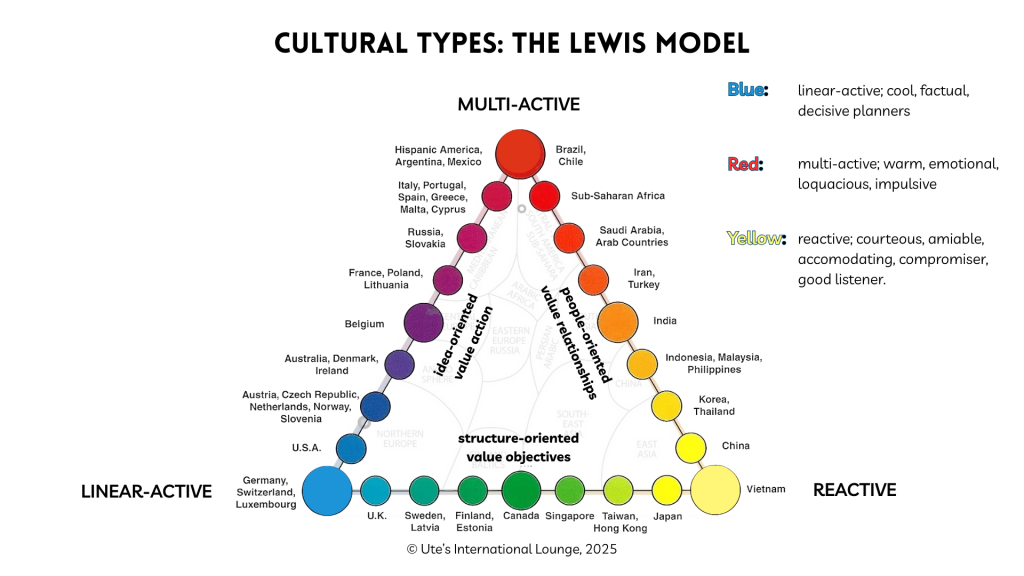
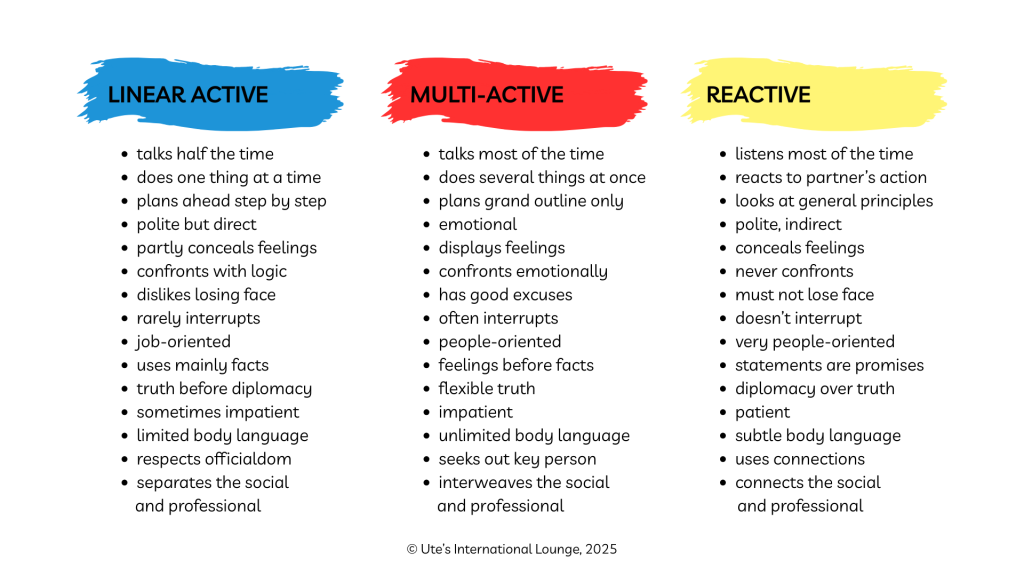
The Lewis Model distinguishes between three dominant communication orientations: Linear-Active, Multi-Active, and Reactive. These orientations describe general tendencies in how people organize time, manage conversations, express emotions, and relate to others. Rather than focusing on geography alone, the model highlights behavioral patterns that can be observed across Europe, Africa, the Middle East, South America, and East Asia.
- Linear-Active cultures are typically task-focused, structured, and fact-oriented. Countries such as Germany, Switzerland, Denmark, and the Netherlands are often cited as examples. Communication tends to be direct, meetings are carefully planned, and punctuality and preparation are highly valued.
- Multi-Active cultures place strong emphasis on relationships, emotional expressiveness, and flexible time management. Southern European countries like Italy, Spain, and Portugal, as well as many South American cultures including Brazil and Argentina, are frequently associated with this style. Conversations are lively, interruptions are common, and personal engagement often takes precedence over formal procedures.
- Reactive cultures prioritize listening, respect, and thoughtful responses. Many East Asian societies, such as China, Korea, and Japan, as well as several Arabic and African cultures, are described in these terms. Communication is often indirect, silence can be meaningful, and maintaining harmony and respect within the group is central.
Strengths of the Lewis Model
One of the key advantages of the Lewis Model lies in its clarity and accessibility. By reducing complex cultural dynamics to three broad orientations, it offers a practical entry point for people who are new to intercultural communication. This makes it particularly useful in international business, education, and family contexts, where quick orientation is often needed.
Another strength is its behavioral focus. Rather than relying solely on abstract cultural values, the model connects culture to observable actions: how people speak in meetings, how they manage time, how they react to disagreement, and how they build trust. This helps users interpret behavior more accurately and avoid personalizing misunderstandings.
The model is also highly applicable in practice. Recognizing that a German colleague’s directness, an Italian partner’s animated discussion style, or a Japanese client’s careful pauses are culturally grounded patterns can significantly reduce friction in multicultural settings. In multinational teams, the Lewis Model supports more balanced meeting structures that integrate efficiency, relationship-building, and reflective listening.
Limitations and Critiques
Despite its usefulness, the Lewis Model also has notable limitations. Most importantly, it works with generalizations, which means it cannot capture the full diversity within any culture. No country or region is internally uniform, and individuals may not conform to the dominant pattern associated with their cultural background.
There is also a risk of oversimplification and stereotyping if the model is applied too rigidly. Labeling someone as “linear-active” or “reactive” can obscure personal, professional, or situational factors that strongly influence communication. Used uncritically, the model may unintentionally reinforce static views of culture rather than encourage curiosity and flexibility.
Furthermore, the model does not fully account for the impact of globalization, migration, and hybrid identities. Many professionals navigate multiple cultural frameworks simultaneously. A project manager in Seoul, a teacher in Madrid, or an entrepreneur in Cairo may combine reactive, multi-active, and linear-active traits depending on context, education, and experience.
Thoughtful Application in Education and Family Contexts
For multilingual families and educators, the Lewis Model can be a valuable reflective tool when used with nuance. Naming different communication preferences helps children and learners understand that differences in interaction are not “right” or “wrong,” but culturally shaped. Teachers can use the model to design classroom practices that respect both outspoken participation and reflective silence, while parents can support children in navigating diverse social norms with confidence and empathy.
Ultimately, the greatest value of the Lewis Model lies not in categorizing others, but in adjusting our own expectations. It invites us to listen more carefully, interpret behavior more generously, and respond more flexibly. When approached as a guide rather than a rulebook, the model supports more respectful, effective, and human-centered communication – across cultures, generations, and contexts.
By engaging with both its strengths and its limits, the Lewis Model becomes a starting point for deeper intercultural understanding rather than an endpoint.
References
Lewis, R. D. (2006). When Cultures Collide: Leading Across Cultures. Boston: Nicholas Brealey Publishing.
In international collaboration, cultural misunderstandings rarely arise from “big” ideological differences. More often, they emerge in everyday situations: how directly feedback is given, how decisions are made, how time is structured, how disagreement is expressed, or how hierarchy is handled.
Practice-oriented cultural models attempt to make precisely these everyday differences visible and discussable.
They are less concerned with abstract values and more with patterns of interaction in professional life. Two of the most influential frameworks in this field are Erin Meyer’s Culture Map and Richard D. Lewis’ linear-, multi-, and reactive culture typology.
Both offer powerful orientation tools. And both require careful, reflective use.
Erin Meyer’s Culture Map: Making Work Patterns Visible
In The Culture Map, Erin Meyer, professor at INSEAD, draws on extensive experience in executive education to map cultural differences along eight behavioral dimensions:
- Communicating (low-context vs. high-context)
- Evaluating (direct vs. indirect negative feedback)
- Persuading (principles-first vs. applications-first reasoning)
- Leading (egalitarian vs. hierarchical expectations)
- Deciding (consensual vs. top-down decision-making)
- Trusting (task-based vs. relationship-based trust)
- Disagreeing (confrontational vs. harmony-oriented styles)
- Scheduling (linear-time vs. flexible-time approaches)
Rather than classifying cultures as fixed types, Meyer positions them on relative scales. The key insight is comparative: a style is not “direct” or “indirect” in absolute terms, but more or less so in relation to another context.
What this model helps us understand
- Why a manager’s “constructive feedback” may feel harsh in one context and vague in another.
- Why silence in a meeting may signal agreement in one culture and respectful dissent in another.
- Why building trust through informal conversations is essential in some environments and perceived as inefficient in others.
In team and organizational training, these dimensions are extremely useful. They offer a shared vocabulary for discussing implicit norms around communication, hierarchy, and decision-making. Instead of personalizing misunderstandings (“She is unprofessional”), teams can reframe them structurally (“We have different expectations about feedback or consensus”).
Where the model is limited
The Culture Map is based primarily on professional, often corporate environments. It simplifies national contexts into dominant tendencies. Regional, generational, class-based, and multilingual variations receive less attention.
Moreover, the model can be misused if read deterministically. A German professional is not automatically “low-context”; a Japanese colleague is not inevitably “hierarchical.” Individual biography, professional culture, personality, and power dynamics intersect with national patterns.
Used uncritically, the framework can harden into the very boxes it aims to clarify.
Richard D. Lewis: Linear-, Multi-, and Reactive Cultures
In When Cultures Collide, Richard D. Lewis proposes a different but equally practice-oriented classification. Based on decades of international consulting, he distinguishes three broad cultural types:
- Linear-active cultures: task-oriented, highly organized, plan-focused, one activity at a time.
- Multi-active cultures: relationship-oriented, flexible with time, multitasking, emotionally expressive.
- Reactive cultures: listening-oriented, harmony-seeking, indirect in disagreement, respectful of hierarchy.
Lewis visualizes cultures in a triangular model, positioning countries closer to one of these poles while allowing for gradations and mixtures.
What this model helps us understand
- Different approaches to time management and punctuality.
- Variations in conversational dynamics (interruptions vs. long listening phases).
- Diverging expectations around emotional expressiveness and formality.
The strength of Lewis’ model lies in its clarity and accessibility. For practitioners, it offers an intuitive starting point for reflecting on interactional styles.
Where the model is limited
The three-type classification is necessarily reductive. It compresses complex societies into broad behavioral clusters. Like all typologies, it risks encouraging essentialist thinking if detached from context.
Furthermore, professional subcultures often override national tendencies. An engineer in São Paulo, a start-up founder in Helsinki, and a diplomat in Seoul may share professional norms that cut across national classifications.
Using Practice-Oriented Models Without Putting People in Boxes
In my work with international teams and multilingual families, I do not “apply” these models. I use them as structured conversation starters.
In organizational settings, selected dimensions from Meyer or Lewis help teams articulate implicit expectations:
- How directly should we give feedback when our team is very international?
- Who is involved in decisions?
- What does reliability mean in our collaboration?
In intercultural communication training for multilingual families, certain elements (for example, hierarchy, emotional expressiveness, or time orientation) support reflection on differing norms around authority, learning, and daily interaction. The aim is not to label family members or colleagues, but to increase empathy and flexibility.
In both contexts, models are most valuable when they are treated as hypotheses rather than diagnoses.
They can illuminate patterns. They cannot explain individuals.
A Reflective Lens, Not a Cultural Verdict
Practice-oriented frameworks such as Meyer’s and Lewis’ succeed because they speak directly to lived experience. They translate abstract cultural differences into observable behaviors.
Yet their very clarity can seduce us into overgeneralization.
Culture is layered, dynamic, situational, and intertwined with language, power, profession, migration history, and personality. No two individuals enact “their culture” in the same way. And, more importantly, individuals change over time!
Used thoughtfully, these models help us ask better questions:
- What expectations am I bringing into this interaction (right now)?
- Which norms feel self-evident to me (at the moment)?
- Where might my interpretation be culturally shaped?
Used uncritically, they risk reinforcing the illusion that culture can be neatly categorized.
The goal, therefore, is not cultural certainty, but cultural literacy: the ability to recognize patterns, hold them lightly, and remain open and flexible to complexity.
Selected References
- Meyer, E. (2014). The Culture Map: Breaking Through the Invisible Boundaries of Global Business. New York: PublicAffairs.
- In my trainings I like to invite participants to try out Erin Meyer's tools on her site. What I particularly appreciate is the continuum vs categories.
- Lewis, R. D. (1996/2006). When Cultures Collide: Leading Across Cultures. London: Nicholas Brealey Publishing.
- Hall, E. T. (1976). Beyond Culture. New York: Anchor Press.
- Hofstede, G. (2001). Culture’s Consequences: Comparing Values, Behaviors, Institutions and Organizations Across Nations (2nd ed.). Thousand Oaks, CA: Sage.
