
Table of Contents
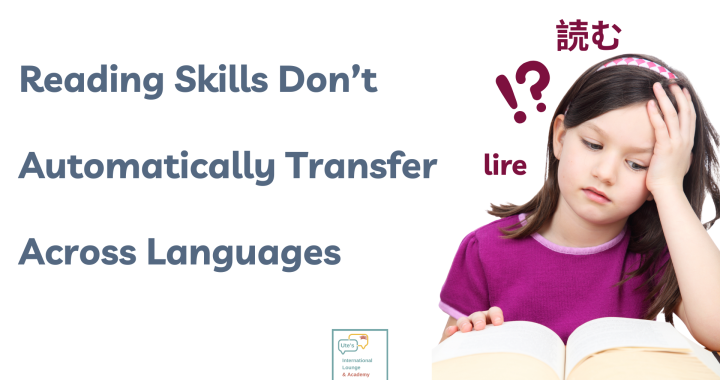
ToggleA persistent belief in literacy education is that “once a child can read, they can read any language”. Decades of cross-linguistic research show that this assumption is misleading (e.g. Seymour, Aro & Erskine, 2003; Share, 2008). The way we learn to read is deeply shaped by the architecture of writing systems. Alphabetic scripts like English, Spanish, Italian, German etc., abjads like Arabic and Hebrew, abudigas like Hindi and morphosyllabic systems like Chinese require different approaches to reading (Ziegler & Goswami, 2005; Perfetti & Harris, 2013).
Skills that support reading in one language do not automatically transfer to another. Strategies learners rely on vary depending on the script, orthography and linguistic structure. Phonological awareness is often highlighted as a foundational skill in English literacy instruction, but it is far from being a universal entry point (Share, 2008; Perfetti & Harris, 2013). In some writing systems syllable awareness plays a stronger early role, in others morphological pattern recognition is central, and in others visual structure and tone carry heavy weight. These are not minor variations. They define how reading is learned.
Understanding this is essential for educators and families supporting multilingual learners, especially when heritage-language literacy is involved.
Reading Across Writing Systems
Writing systems differ with regards to which linguistic unit they encode:
- Alphabetic systems (e.g. English, Italian, Spanish, German) represent phonemes, i.e. individual speech sounds.
- Abjads (e.g. Arabic, Hebrew) primarily represent consonants, with vowels often omitted.
- Abugidas (e.g. Hindi/Devanagari) represent consonant–vowel units.
- Morphosyllabic systems (e.g. Chinese) represent morphemes and syllables rather than individual sounds.
- Mixed systems (e.g. Korean) combine alphabetic principles with syllabic organization.
Research on reading across languages consistently shows that these structural differences are consequential. Writing systems impose distinct processing demands on readers and instructional practices must respond to those demands rather than assume a universal single model of reading (Verhoeven & Perfetti, 2017).
These structural properties shape which cognitive skills are foregrounded in early reading instruction:
- Shallow/transparent alphabetic scripts (Italian, Spanish, German) allow children to learn consistent letter–sound rules quickly. Syllable awareness is often sufficient at first. Example: A Spanish child who learns that ma–me–mi–mo–mu always sound the same can reliably decode new words like mamá or mesa on first encounter. The decoding system is predictable, so early success depends more on syllable blending than on memorizing exceptions.
- Intermediate scripts (French, Russian, Vietnamese) require attention to patterns, morphology, and prosody. Example: In French, parle and parlent sound almost identical but signal different grammatical meanings. Readers must attend to silent letters and morphological endings, not just pronunciation. In Russian, stress placement can change vowel quality, so children must learn to track prosodic patterns alongside decoding.
- Deep/opaque scripts (English) emphasize phonemic awareness, rimes, and morphological instruction. Example: A child reading through, though, tough, and bough cannot rely on a single sound rule for -ough. They must learn flexible decoding strategies and use meaning and morphology to stabilize spelling patterns. English preserves word families visually – sign, signal, signature – even when pronunciation shifts.
- Abjads rely heavily on morphological awareness (roots and patterns). Example: In Arabic, recognizing the root K–T–B allows readers to connect kitāb (book), kātib (writer), and maktab (office). Even when short vowels are not written, morphological structure guides interpretation. Reading is anchored in pattern recognition as much as sound decoding.
- Abugidas focus on syllable decoding and visual discrimination. Example: In Devanagari, the base consonant carries an inherent vowel that changes through visual modifications. Children learn to read syllable units such as का /ka/ vs कि /ki/ by tracking small graphic changes that signal vowel shifts. Precision in visual parsing is essential.
- Morphosyllabic systems prioritize radical recognition, tone, and morphology. Example: A Chinese reader encountering the character 妈 (mother) uses both the semantic radical 女 (“female”) and the phonetic component 马 to infer meaning and pronunciation. Reading depends on recognizing internal character structure, not assembling phonemes.
- Mixed systems (Korean) combine phoneme and syllable awareness, often learned rapidly due to regularity. Example: Korean readers map individual letters to sounds but process them in syllable blocks such as 한 or 글. Children simultaneously decode phonemes and construct visually organized syllables, integrating sound and spatial structure.
These examples illustrate a broader point: reading instruction is not simply about learning to “sound out” words. It is about learning how a particular writing system encodes language, and adjusting cognitive strategies accordingly.
Why This Matters for Multilingual Learners
Multilingual learners are not starting from zero when they encounter a new literacy system. But they are often entering from a different literacy logic. Skills that support reading in one script may not transfer in a straightforward way to another.
- A child literate in Spanish approaches English reading differently than a child literate in Chinese or Arabic.
- Transfer depends on script similarity and the grain size of transferable skills involved (phoneme, syllable, or morpheme).
- Models derived from English cannot be applied indiscriminately in multilingual classrooms without risking misrepresentation of learners’ abilities.
Comparative research across major writing systems, including Japanese, Chinese and Korean, documents both shared cognitive principles and script-specific processes that challenge English-centered models of literacy (Verhoeven & Perfetti, 2017).
Recognizing these differences allows educators and families to align support with the actual cognitive demands of each writing system.
Concrete Examples: What Transfer Actually Looks Like
Consider a child who learned to read in Spanish and later begins reading in English. Spanish decoding relies on highly consistent sound–letter mappings. English, by contrast, requires attention to irregular spellings, morphological cues, and larger units such as rimes. The child is not lacking reading ability. They are adapting to a different decoding architecture. What looks like hesitation or even regression is often restructuring in progress.
Now consider a simultaneous multilingual child who speaks Arabic at home but receives literacy instruction only in English. When the family later introduces Arabic reading, the challenge is not intelligence or motivation. Arabic literacy depends heavily on recognising consonantal roots and morphological patterns that are visually and cognitively distinct from alphabetic decoding in English. The child must learn a new key to unlock meaning despite already being literate.
Research in cross-linguistic literacy consistently shows that transfer is selective and grain-size dependent: phoneme-level skills transfer differently than syllable- or morpheme-level skills, and the direction of transfer depends on script similarity. Literacy does not move intact from one language to another. It reorganizes (Koda, 2007).
These patterns are not abstract linguistic details. They directly shape how reading instruction succeeds or fails. Comparative research shows that different orthographies require learners to prioritize different types of information, from phonology in alphabetic systems to morphological or visual cues in others. These priorities determine how reading skills transfer across languages (Verhoeven & Perfetti, 2017).
Practical Implications
Whether you are a teacher designing multilingual classroom lessons, a researcher exploring cross-linguistic literacy, or a parent supporting heritage-language reading, the implications are concrete:
- Identify which skills are central at different stages of literacy in each language.
- Avoid assuming that strategies from one language will automatically work in another.
- Tailor instruction and support to the specific cognitive demands of each writing system.
What Research Consistently Shows
Studies in comparative literacy development demonstrate that orthographic structure shapes the trajectory of reading acquisition (Seymour et al., 2003; Ziegler & Goswami, 2005). Transparent orthographies promote rapid decoding accuracy. Deep (opaque) orthographies demand extended phonemic and morphological training. Morphosyllabic systems prioritise visual and morphological processing. These are not pedagogical preferences. They are cognitive responses to writing system design (Dehaene, 2009).
Verhoeven and Perfetti (2017) bring together research on reading in 17 languages across major types of writing systems. Their volume provides a comparative framework showing that literacy development is systematically influenced by script structure. It challenges the assumption that reading models derived from a single language – most often English – can serve as universal template. Instead, it shows that literacy development reflects both shared cognitive mechanisms and script-specific pathways.
Together, this body of research positions literacy as a language-specific cognitive achievement shaped by orthographic design rather than a single transferable skill.
Bridging Research and Practice
Understanding how literacy restructures across languages is central to my broader framework of sustainable multilingual development. This perspective recognizes that multilingual growth is not only about maintaining languages, but about supporting them in ways that respect their structural and literacy realities.
In my work with families and educators, tools such as the Dominant Language Constellation (DLC) and the Language Timeline© help map multilingual experiences over time. While they are not reading programs, they provide a structured way to understand how languages interact in a learner’s life, an essential step when making informed decisions about literacy support across different writing systems.
Cross-linguistic literacy research makes one point unmistakable clear: multilingual learners are navigating multiple architectures of reading. When educators and families understand this, they can respond with greater precision, fairness, and confidence.
These frameworks exist to translate research into practice – not by simplifying multilingualism, but by making its structure legible.
Multilingual literacy is not a deficit to repair. It is a complex developmental process that requires informed guidance. When families and educators understand how writing systems shape reading, they can move beyond myths of universal transfer and make decisions grounded in linguistic reality. That shift is essential for fair assessment, effective instruction, and sustainable multilingual development.
If multilingual learners are to thrive, literacy support must respect the architecture of every language they read.
I invite you to also read the LinkedIn version of this article and watch my video and join the conversation in the comments.
Selected References
Dehaene, S. (2009). Reading in the brain: The science and evolution of a human invention. Viking.
Koda, K. (2007). Reading and language learning: Crosslinguistic constraints on second language reading development. Language Learning, 57(s1), 1–44.
Perfetti, C. A., & Harris, L. N. (2013). Universal reading processes are modulated by language and writing system. Language Learning and Development, 9(4), 296–316.
Seymour, P. H. K., Aro, M., & Erskine, J. M. (2003). Foundation literacy acquisition in European orthographies. British Journal of Psychology, 94, 143–174.
Share, D. L. (2008). On the Anglocentricities of current reading research and practice: The perils of overreliance on an “outlier” orthography. Psychological Bulletin, 134(4), 584–615.
Verhoeven, L., & Perfetti, C. (Eds.) (2017). Learning to Read across Languages and Writing Systems: Cambridge: Cambridge University Press.
Ziegler, J. C., & Goswami, U. (2005). Reading acquisition, developmental dyslexia, and skilled reading across languages: A psycholinguistic grain size theory. Psychological Bulletin, 131(1), 3–29.
Why phonological awareness is not a universal starting point
A structural perspective on how writing systems shape multilingual reading.
Learning to read is often discussed as if it were a single, transferable skill: once a child can read, they can readany language. Decades of cross‑linguistic research in multilingualism and literacy development have shown that learning to read is not a single, universally transferable skill (Koda, 2007; Perfetti & Harris, 2013). The learning process varies significantly across languages and scripts. The extent to which skills transfer from one language to the other depends on multiple factors such as orthographic depth, phonological structure, morphological cues, writing system similarity and instructional context (Ziegler & Goswami, 2005; Koda & Zehler, 2008).
Reading acquisition is deeply shaped by the structure of the writing system. What learners must attend to – individual sounds, syllables, morphemes, or visual patterns – depends entirely on what the script encodes (Frost, 2012; Dehaene, 2009). As a result, reading instruction developed for one language, especially English, cannot simply be transferred to others (Seymour, Aro, & Erskine, 2003; Share, 2008).
This becomes particularly relevant in multilingual classrooms, where learners may already be literate in a different language and writing system. These multilingual learners are not “starting from zero”, but they are often starting from a different literacy logic (Koda, 2007; Perfetti & Harris, 2013).
This perspective is central to what I call sustainable multilingual development: supporting languages in ways that align with how literacy systems actually work.
This article offers an overview of how reading is taught across major writing systems, using examples from English, French, Italian, German, Spanish, Russian, Chinese, Arabic, Hebrew, Hindi, Greek, Korean, and Vietnamese.
Writing systems and what they represent
At a fundamental level, writing systems differ in which linguistic unit they encode:
- Alphabetic systems represent phonemes (individual speech sounds)
- Abjads represent primarily consonants
- Abugidas represent consonant–vowel units
- Morphosyllabic systems represent morphemes and syllables
- Mixed systems combine alphabetic principles with syllabic organization
These structural differences directly determine which cognitive skills are trained first in reading instruction, and which strategies readers come to rely on (Daniels & Share, 2018; Frost, 2012).
Alphabetic writing systems
A shared principle with crucial differences
All alphabetic systems require learners to connect written symbols to spoken language. However, the consistency of these connections, known as orthographic depth, varies considerably (Ziegler & Goswami, 2005; Seymour, Aro & Erskine, 2003).
This variation explains why phonological awareness plays very different roles across alphabetic languages and why its centrality in English should not be treated as universal.
Shallow (transparent) orthographies
Languages: Italian, Spanish, German, Greek
In shallow orthographies, letter–sound correspondences are highly consistent. Once decoding rules are learned, they apply reliably across words.
Reading instruction typically focuses on:
- systematic phonics
- syllable-based decoding
- a rapid shift from decoding to fluency and comprehension
Example: In Italian, learning that c before a is /k/ and ch before e is also /k/ covers nearly all relevant cases. Children usually achieve accurate decoding within the first year of instruction (Seymour et al., 2003).
Role of phonological awareness: Phonological awareness is important, but phonemic awareness is not the main bottleneck. Many children succeed initially with syllable awareness, and phoneme-level precision develops naturally through reading.
Intermediate orthographies
Languages: French, Russian, Vietnamese
These systems combine relatively systematic sound–letter relations with important exceptions.
Typical challenges include:
- silent letters and grammatical spelling (French)
- stress variability (Russian)
- interactions between letters, tones, and diacritics (Vietnamese)
Reading instruction therefore emphasizes:
- phonics combined with pattern recognition
- early morphological awareness (especially in French)
- attention to prosody and stress (Russian)
Example: In French, parle and parlent sound nearly identical but differ in spelling for grammatical reasons. Understanding morphology becomes essential very early.
Role of phonological awareness: Phonological awareness remains important, but it is not sufficient on its own. Morphological knowledge strongly supports accurate reading and comprehension.
Deep (opaque) orthographies
Language: English
English stands out among alphabetic systems due to its highly inconsistent spelling–sound correspondences and strong morphological and etymological layering (Share, 2008; Frost, 2012).
Reading instruction typically emphasizes:
- explicit phonemic awareness training
- phonics combined with morphological instruction
- larger units such as rimes (-ight, -ough)
Example: The words sign, signal, and signature illustrate how English spelling preserves meaning rather than pronunciation.
Role of phonological awareness: In English, phonemic awareness is a central predictor of reading success, and weaknesses in this area are strongly associated with reading difficulties. This prominence, however, is language-specific, not universal.
Abjads: consonant-based systems
Languages: Arabic, Hebrew
In abjads, letters primarily represent consonants, while vowels are optional and often omitted in everyday texts.
Instructional progression typically includes:
- fully vowelled texts for beginners
- gradual removal of vowel markings
- increasing reliance on morphology and context
Key cognitive skills:
- morphological awareness (root-and-pattern systems)
- consonantal phonological awareness
- visual pattern recognition
Example: In Arabic, the root K–T–B relates to writing (kitāb ‘book’, kātib ‘writer’). Recognizing the root allows readers to access meaning even without written vowels.
Role of phonological awareness: Phonological awareness plays a role, but morphological awareness is central from an early stage, far more so than in alphabetic systems like English (Perfetti, Liu & Tan, 2005; Frost, 2012).
Abugidas: consonant–vowel units
Language: Hindi (Devanagari)
In abugidas, each symbol represents a consonant with an inherent vowel, which can be systematically modified.
Reading instruction typically emphasizes:
- syllable-based decoding
- highly consistent symbol–sound mappings
- visual discrimination of complex characters
Role of phonological awareness: Syllabic awareness is particularly strong. Phoneme-level awareness develops, but it is not the primary entry point into reading.
Morphosyllabic systems
Language: Chinese
Chinese characters represent morphemes and syllables rather than individual sounds.
Reading instruction typically emphasizes:
- character recognition
- radical awareness (semantic and phonetic components)
- morphological compounding
Example: The character 妈 (mā, ‘mother’) contains a semantic radical linked to meaning and a phonetic component offering pronunciation cues.
Role of phonological awareness: Phonemic awareness is not central. Instead, syllable awareness, tone awareness, and morphological knowledge are crucial for reading development (McBride-Chang et al., 2005; Perfetti & Harris, 2013).
Mixed systems
Language: Korean
Korean uses alphabetic symbols arranged into syllable blocks.
Reading instruction typically emphasizes:
- letter–sound correspondence
- syllable block construction
- integration of visual and phonological processing
Role of phonological awareness: Both phoneme-level and syllable-level awareness are involved. Due to high regularity, decoding is usually mastered quickly.
Visual summary: Reading across writing systems

Translanguaging without script awareness: a hidden risk
Translanguaging practices are increasingly promoted in multilingual classrooms often with good intentions. However, when translanguaging is used without an understanding of writing systems, a crucial explanatory layer is missing.
Teachers may encourage learners to draw on their home-language literacy without realizing that:
- the unit of analysis differs across scripts,
- strategies that are effective in one writing system may be ineffective or misleading in another,
- multilingual learners may struggle not with reading itself, but with understanding how the new/other system works.
Without script awareness, translanguaging risks remaining superficial, valuing languages socially while overlooking their structural literacy demands.
What this means for multilingual learners
A common misconception is that phonological awareness automatically transfers across languages. In reality:
- transfer depends on script similarity
- skills transfer at different grain sizes (phoneme, syllable, morpheme) (Koda, 2007; Perfetti & Harris, 2013)
- a child literate in Spanish approaches English reading very differently from a child literate in Chinese or Arabic
Applying English-based reading models indiscriminately can therefore misrepresent multilingual learners’ abilities and lead to inappropriate instructional decisions or diagnoses.
Key takeaway
There is no single pathway into reading.
Phonological awareness is a powerful tool, but its form, timing, and importance are shaped by the writing system. Effective reading instruction, and effective translanguaging practice, require explicit awareness of these structural differences.
Only then can educators and families support multilingual learners across developmental paths in navigating not just a new language, but a new literacy system.
Transfer does not fail — it restructures, and recognizing this restructuring is essential for fair, evidence-informed literacy policy and practice in multilingual education.
Literacy transfer is not plug-and-play – it is constrained by the architecture of writing systems.
Selected bibliography
Dehaene, S. (2009). Reading in the brain: The new science of how we read. Viking.
