
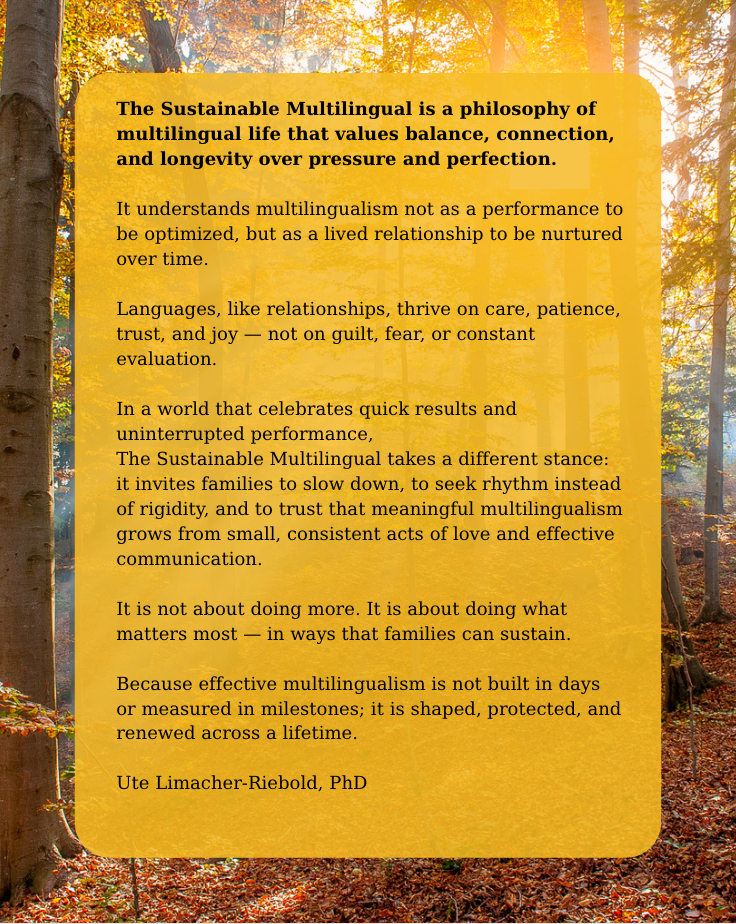
The Sustainable Multilingual™ is the philosophy that underlies everything I do—from language learning and multilingual development to intercultural communication.
It is based on the idea that multilingualism should support long-term viability, identity coherence, and relational wellbeing rather than short-term performance or externally imposed language outcomes.
Multilingualism is not a race, a checklist or a temporary project.
It is a way of living with languages and cultures across changing life phases, contexts and relationships.
A sustainable multilingual approach recognizes that languages evolve differently over time. Dominance shifts, contexts change, identity develops. What matters is not perfect balance or continuous control, but the creation of conditions that remain livable, meaningful and sustainable over time.
When multilingualism is sustainable, it does not depend on constant enforcement.
It becomes integrated into communication, relationships, identity and everyday life – at a pace that is individual and allowed to evolve.
If a multilingual strategy only works while someone is enforcing it, it is not sustainable.
This perspective informs the Sustainable Multilingual™ Framework and its application across educational, professional and individual contexts.
On this page I share small reflections, quotes and insights that you can also find on my instagram account @UtesInternationalLounge.
(this post has been published on Linkedin)
©Ute Limacher-Riebold, 2025
Over the years, I’ve seen how easy it is for families, educators, and professionals to feel pressure in their multilingual journeys: to do more, speak more, achieve more.
But multilingualism is not a sprint, it is not a project that finishes. It is a lifelong relationship with our languages that requires care, attention, and patience.
It needs care, not competition. Attention, not anxiety.
Too often, multilingualism is treated like a sprint: learn faster, speak better, achieve more. But quick fixes rarely last. Languages, like relationships, thrive when nurtured gently and steadily.
That’s why I propose the philosophy of The Sustainable Multilingual™ – an approach that embraces multilingual growth as something lasting, sustainable, and connected to our well-being. It is about:
· Valuing what we already know, rather than starting over
· Maintaining languages with patience and small, consistent effort
· Supporting families, teachers, and professionals without exhaustion or guilt
· Recognizing that linguistic well-being is tied to emotional and physical health
Research shows that multilingualism is much more than performance, it has real cognitive and health benefits across the lifespan:
· The Lifelines Study (Keijzer et al., 2025) analysed over 11,000 older adults and found a positive relationship between the number of languages learned and cognitive functioning, including processing speed, attention, and working memory.
· A recent large-scale study published in Nature Aging (2025) showed that speaking multiple languages is linked to slower biological aging, based on data from more than 86,000 adults across 27 European countries.
· Earlier research also highlights cognitive benefits: bilingual adults show better executive function and cognitive reserve, which can protect against age-related decline (Bak et al., 2014).
· Bilingualism and multilingualism are additionally linked to better overall cognitive flexibility and mental functioning (Kroll & Bialystok, 2013).
When multilingualism is sustainable, it becomes part of who we are, not just what we do. It brings health and connection across generations and cultures.
My goal with The Sustainable Multilingual™ is to start a movement that helps families, educators, and professionals slow down, reflect, and rediscover the pleasure and value of living with multiple languages.
Because multilingualism is not about perfection – it’s about presence. Not about doing more – but doing what matters most, in ways that can last.
How do you nurture your multilingualism – and that of your family, students, or clients – in ways that last?
References:
Bak, T. H., Nissan, J. J., Allerhand, M. M., & Deary, I. J. (2014). Does bilingualism influence cognitive aging? Annals of Neurology, 75(6), 959–963.
Kroll, J. F., & Bialystok, E. (2013). Understanding the consequences of bilingualism for language processing and cognition. Journal of Cognitive Psychology, 25(5), 497–514.
Keijzer, M., Knooihuizen, R., Loerts, H., Brouwer, J. & van den Berg, F. (2025). Association Between Multilingual Experience Factors and Cognitive Functioning in Older Adults: A Lifelines Study. The Journals of Gerontology: Series B, Volume 80, Issue 3, March 2025. https://doi.org/10.1093/geronb/gbae200
Amoruso, L., Hernandez, H., Santamaria-Garcia, H. et al. Multilingualism protects against accelerated aging in cross-sectional and longitudinal analyses of 27 European countries. Nat Aging (2025). https://doi.org/10.1038/s43587-025-01000-2
© Ute Limacher-Riebold, 2026
(this post was published on Linkedin)
Sustainability is usually discussed in ecological or economic terms. Yet at its core, sustainability refers to the long-term viability of complex interdependent systems. Multilingualism is such a system.
From this perspective, Sustainable Multilingualism is not about maximizing the number of languages, but about maintaining multilingual repertoires in ways that are cognitively, emotionally, socially, and educationally sustainable over time.
A sustainable multilingual setup is characterised by:
– realistic linguistic expectations instead of idealised native-like norms
– continuity rather than short-term performance optimisation
– alignment between family practices, educational settings, and societal demands
– attention to well-being, identity development, and life-course changes
What is often framed as “language loss” is, in many cases, a sign of unsustainable conditions: overload, pressure, lack of institutional support, or conflicting ideologies about language value.
Unsustainable multilingualism typically produces: – chronic parental insecurity and guilt – children who associate languages with stress rather than meaning – educational systems that privilege measurable outcomes over durable competence – abrupt language abandonment once effort exceeds perceived reward
A sustainability-oriented approach therefore shifts the central question: not Which languages should be learned?but
- Can this multilingual constellation be maintained over years and transitions?
- Does it support learning, relationships, and identity development?
- Is it resilient to change?
Sustainable Multilingualism is not a call for less multilingualism. It is a call for multilingualism that lasts.
I'd like to hear your reflections:
Where do you see sustainability principles missing in current multilingual education or family language planning — and how can those gaps be filled?
Selected references for further reading (illustrative, not exhaustive):
• Buschfeld, R. & Vida-Mannl (2023), Multilingualism: A Sociolinguistic and Acquisitional Approach — recent comprehensive overview of multilingual repertoires, policy, and identity. – Comprehensive recent overview of multilingual repertoires, policy and identity.
• Grosjean, F. (2010). Bilingual: Life and Reality. Harvard University Press. – Foundational work on bilingualism as a dynamic, lived system.
• Hornberger, N. H. (2003). Continua of Biliteracy: An Ecological Framework for Educational Policy, Research, and Practice in Multilingual Settings. Multilingual Matters. – Classic ecological framework still widely referenced in sustainability-oriented work.
• Literacy for Sustainable Education (Sustainability, 2024) — multilingualism as inclusive and sustained pedagogy. – Empirical studies showing how sustained, scaffolded multilingual curricula support academic success across diverse student populations.
• Multilingual Education for Sustainable Development (Prospects, 2025) — evidence on additive multilingual education and epistemic inclusion. – Evidence for additive multilingual education and epistemic inclusion.
• UNESCO (2025), Languages Matter: Global Guidance on Multilingual Education — up-to-date principles for multilingual language-in-education policy. – Policy framework highlighting home languages as a cornerstone of sustainable, inclusive education.
• Weidl & Erling (2025), Linguistically and Culturally Responsive English Language Education — pedagogical implications of multilingual resources. – Pedagogical implications of mobilising learners' full linguistic resources for sustainable teaching practices.
(this post was published on Linkedin)
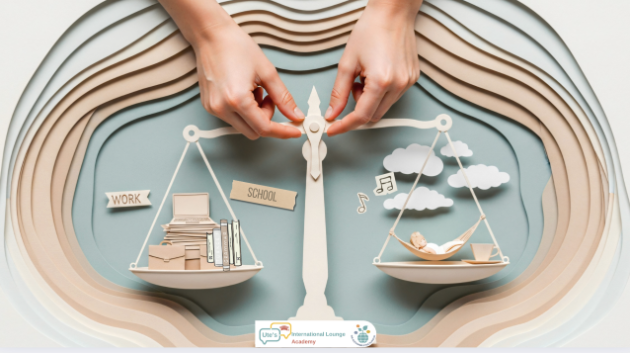 Many multilingual families and educators carry an unspoken pressure: the constant sense that they’re not doing enough. Not enough conversations. Not enough practice. Not providing the “right” or “perfect” input (whatever that may be).
This perception is widespread, yet it often overlooks a crucial truth: sustainable multilingual development grows through what we already do consistently, meaningfully and in connection with daily life.
Research in language acquisition shows that progress in more than one language does not depend on perfection, but on repeated, contextualised and meaningful interaction – the kind that fits naturally into children’s daily routines and experiences (De Houwer, 2021; Paradis, Genesee & Crago, 2011).
Some of the most powerful contributors to long-term multilingual development are already woven into everyday routines:
Everyday conversations – Talking about the day, narrating routines or exploring favourite topics strengthens vocabulary, grammar and discourse in meaningful context (Paradis, Genesee & Crago, 2011).
Favourite books revisited – Returning to familiar stories deepens comprehension, narrative skills and prediction, while nurturing a stable and positive relationship with the language (Sénéchal & LeFevre, 2002).
Songs, routines, family expressions – Recurring, predictable elements reinforce language patterns and support phonological awareness and memory through rhythm and repetition (Gromko, 2005).
Comfort languages during emotional moments – Children often turn to a particular language when seeking reassurance or comfort and expressing strong feelings. Respecting this instinct strengthens both language development and emotional security (Cummins, 2001).
These habits are far from incidental; they form the foundation of a sustainable multilingual environment. They show that languages develop reliably, not through constant pressure or maximised input, but through authentic interactions that are naturally embedeed in family life, teaching contexts and relational connections.
In the coming weeks, I will explore further ways to strengthen what already works – without adding new layers of obligation or strain.
In the meantime, consider this:
What multilingual habits are already part of your daily life?
How do they support your children, your students, or your own languages?
When we recognise and value what we’re already doing well, the pressure to be perfect fades. This makes space for calm, steady routines – and that’s where languages can truly grow.
References
Cummins, J. (2001). Negotiating identities: Education for empowerment in a diverse society. Los Angeles: California Association for Bilingual Education.
De Houwer, A. (2021). Bilingual Development in Childhood. Cambridge: Cambridge University Press.
Gromko, J. E. (2005). The effect of music instruction on phonemic awareness in beginning readers. Journal of Research in Music Education, 53(3), 199–209.
Hoff, E. (2020). Language Development (6th ed.). Cengage Learning.
Paradis, J., Genesee, F., & Crago, M. (2011). Dual Language Development and Disorders: A Handbook on Bilingualism and Second Language Learning (2nd ed.). Brookes Publishing.
Sénéchal, M., & LeFevre, J.-A. (2002). Parental involvement in the development of children’s reading skill: A five-year longitudinal study. Child Development, 73(2), 445–460.
Ever wondered why multilinguals switch between languages within the same sentence?
The Matrix Language Frame (MLF) Model (Myers-Scotton, 1993, 2002) explains that during intra-sentential code-switching, the two languages don’t play equal roles (intrasentential = within the same sentence).
I normally use the term Code-Mixing to describe the use of two or more codes (languages) within one sentence vs. Code-Switching, which is the use of two or more languages within a conversation, i.e. using different languages whilst speaking with different people. (you can find videos and posts about it on my sites and youtube channels)
 The Matrix Language (ML) provides the grammatical frame — it’s the backbone of the sentence.
The Embedded Language (EL) supplies words or phrases that fit into that frame.
So even when we blend languages, there’s a hidden structure, not chaos!
Multilingual speakers don’t “break” grammar; they expand it creatively!

Myers-Scotton, C. (1993). Duelling Languages: Grammatical Structure in Code-Switching. Oxford: Clarendon Press.
Myers-Scotton, C. (2002). Contact Linguistics: Bilingual Encounters and Grammatical Outcomes. Oxford University Press.
 The Many Faces of Code-Mixing
When we multilinguals mix our languages, we don’t just “throw in a word or two” – it happens in structured and fascinating ways. 

Linguists distinguish several levels of code-mixing depending on how deeply the languages intertwine:
Lexical level – borrowing or inserting single words or short phrases:
“Ich liebe brunches am Sonntag.”
(English word inserted into a German sentence)
Morphological level – mixing within the word itself, by adding an affix from one language to a base from another:
“Ich whatsapp-e dich später.”
(English root + German verb suffix)
Syntactic level – blending grammatical structures or clauses from two languages:
“If it rains, bleiben wir zu Hause.”
(English main clause + German subordinate clause)
– Depending on the level of proficiency, the code-switching can look differently. I talk about this in my trainings and webinars.
These patterns show that code-mixing isn’t random – it follows linguistic rules and reflects a speaker’s mastery of both systems. 
Code-mixing allows us to express ourselves precisely, connect with others, and keep all our languages alive and active.
That’s sustainable multilingualism in action! 
Myers-Scotton, C. (1993). Duelling Languages: Grammatical Structure in Code-Switching. Oxford: Clarendon Press.
Poplack, S. (1980). Sometimes I’ll Start a Sentence in Spanish Y TERMINO EN ESPAÑOL: Toward a Typology of Code-Switching. Linguistics, 18(7–8), 581–618.
Muysken, P. (2000). Bilingual Speech: A Typology of Code-Mixing. Cambridge University Press.
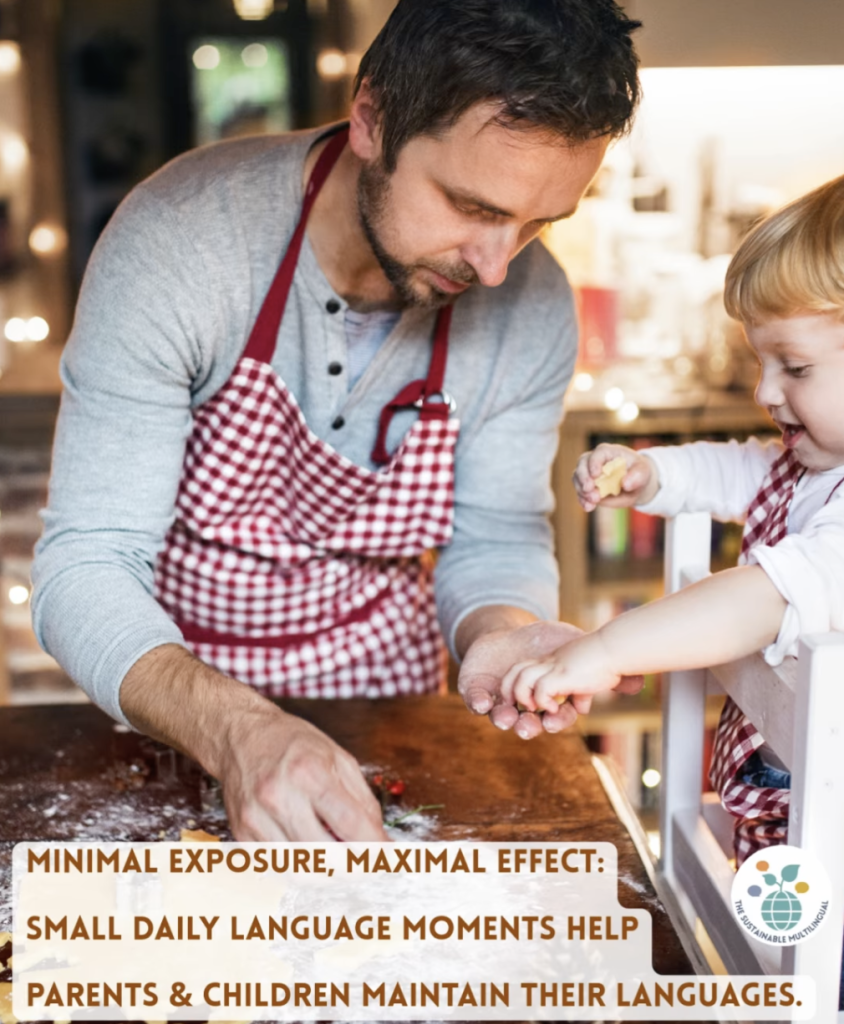
Minimal exposure, maximal effect.
Sustainable multilingualism doesn’t rely on long sessions or perfectly structured activities.
It grows through small, daily language moments that help both parents and children keep their languages active and emotionally connected.
A short exchange while getting ready, a song in the car, a shared joke at dinner – these micro-interactions accumulate.
What matters most is frequency and emotional presence.
Consistency builds the neural pathways that make each language feel familiar, safe, and usable over time (De Houwer 2007; Paradis 2011).
When families intentionally create these everyday moments, each language maintains its place in the child’s world – and in the parent’s world too!
 Which tiny language moment shaped your day today?
References
• De Houwer, A. (2007). Parental language input patterns and children’s bilingual use. Applied Psycholinguistics.
• Paradis, J. (2011). Individual differences in child bilingualism. Linguistic Approaches to Bilingualism.
• Grosjean, F. (2010). Bilingual: Life and Reality. Harvard University Press.

 Myth: “Only children need daily practice.”
 Fact: Parents’ routines matter just as much.
Multilingual development doesn’t happen in isolation.
Children build their languages within the entire family ecosystem; so when parents keep their own languages active, the benefits ripple outward.
Your reading habits, your conversations with relatives, the media you enjoy, even the words you choose when you’re tired… they all model what sustainable multilingualism looks like in everyday life.
Research consistently shows that the quality and regularity of input - across all ages - shape how languages are maintained in the long run (Scheele et al. 2010; De Houwer 2020).
When parents invest in small, consistent routines, children see these languages as living, valuable, and worth using.
Sustainable multilingualism truly is a family practice.
 What part of your routine keeps your language alive?
References
• Scheele, A., Leseman, P., & Mayo, A. (2010). The home language environment of monolingual and bilingual children. Applied Psycholinguistics.
• De Houwer, A. (2020). Harmonious Bilingualism: Well-being for families in bilingual settings. Cambridge University Press.
• Surrain, S. (2021). Family language policy and its impact on child bilingualism. Journal of Multilingual and Multicultural Development.

Children don’t learn languages primarily from explanations, they learn from observation.
When they see parents reading, thinking, laughing, and switching naturally between languages, multilingualism becomes part of everyday life rather than a task to complete.
Research shows that children are more likely to use and maintain their languages when they experience them as meaningful social practices, not as structured exercises imposed from above (Bandura 1977; De Houwer 2018).
Consistent modeling communicates a powerful message: these languages belong here!
Lesson plans can support learning, but it is lived multilingualism that sustains it.
 Small, authentic habits – repeated daily – shape motivation far more effectively than any worksheet ever could.
 Which multilingual habit are you modeling today?
References
• Bandura, A. (1977). Social Learning Theory. Prentice Hall.
• De Houwer, A. (2018). The role of language input and family interaction in bilingual development. In Bilingual Cognition and Language.
• Lanza, E. (2004). Language Mixing in Infant Bilingualism. Oxford University Press.
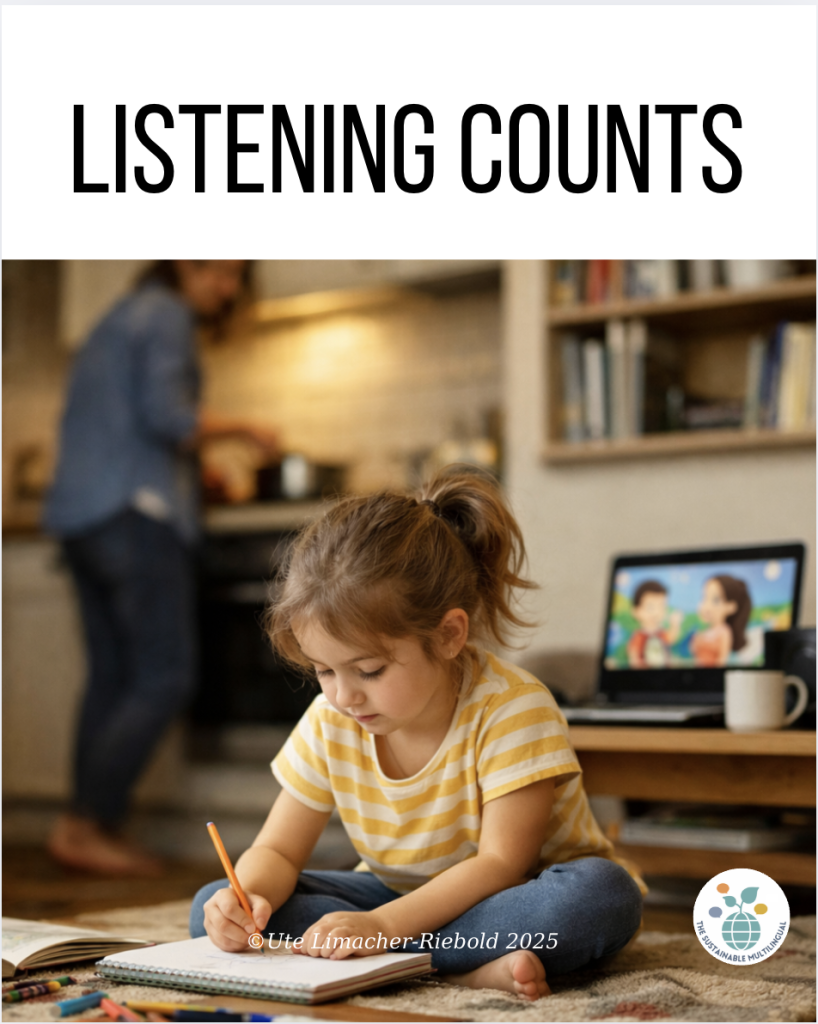
Passive exposure keeps languages alive for everyone in the family.
Languages do not disappear the moment we stop actively “practicing” them.
Listening to conversations, having background audio, watching familiar shows, or simply being surrounded by a language continues to reinforce comprehension, emotional connection, and accessibility – for children and adults.
Research on language maintenance shows that passive exposure supports lexical access, listening skills, and long-term retention, especially when it is regular and emotionally meaningful (Schmid 2011; Hulstijn 2015).
These low-effort forms of contact reduce pressure while keeping languages present in daily life.
Sustainable multilingualism thrives when languages are allowed to breathe in the background of family routines.
Not every moment needs output – sometimes listening is enough.
Which language is quietly accompanying your day today?
References
• Schmid, M. S. (2011). Language Attrition. Cambridge University Press.
• Hulstijn, J. H. (2015). Language proficiency in native and non-native speakers. John Benjamins.
• Grosjean, F. (2010). Bilingual: Life and Reality. Harvard University Press.
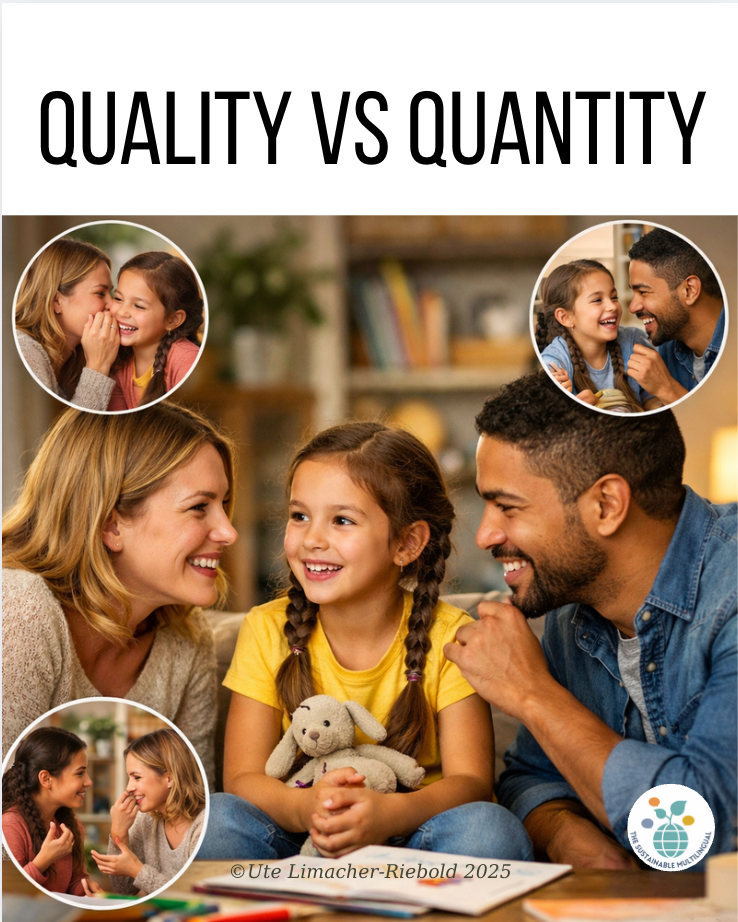
Quality over quantity: meaningful conversations benefit both children and parents.
In multilingual families, it is not the number of words or hours that makes the difference – it is the quality of interaction. Short but meaningful conversations, where attention, emotion, and intent are present, support deeper language processing than long periods of unfocused exposure.
Research in child bilingualism and interactional linguistics consistently shows that responsive, emotionally engaged exchanges foster vocabulary growth, narrative skills, and long-term language maintenance – for children and adults (Hoff 2006; Rowe 2012). Language thrives where it carries meaning, not where it simply fills time.
Sustainable multilingualism grows in moments of real connection. A thoughtful question, a shared story, a genuine reaction can be enough.
Which meaningful conversation stayed with you today?
References
- Hoff, E. (2006). How social contexts support and shape language development. Developmental Review.
- Rowe, M. L. (2012). A longitudinal investigation of the role of quantity and quality of child-directed speech. Child Development.
- De Houwer, A. (2020). Harmonious Bilingualism. Cambridge University Press.
Language shift is a structural part of multilingual lives, not a personal shortcoming.
In this video, I look at language shift through the lens of The Sustainable Multilingual and the Dominant Language Constellation: how languages reorganize themselves over time as our life circumstances change.
I invite you to reflect and consider this:
• Which languages are part of your current linguistic constellation?
• Which ones carry your everyday life right now?
• And how has this constellation changed over the years?
There is no fixed or “ideal” balance.
Sustainable multilingualism is about understanding change and learning to work with it, rather than against it.
If you’ve seen my earlier video on language shift, this one adds a complementary perspective
by looking at what these shifts mean in lived multilingual lives.
I'm curious to know which ones of your languages shifted into the background or foreground?
